


 Between Industry and Wonder: My Days in Yeosu
Most travelers in South Korea skip Yeosu. It’s not on the classic tourist route, and when you first arrive, the sight of smokestacks and industry can be a little discouraging. Still, I chose to stay here — not because it was the easiest option, but because I wanted a base for exploring the quieter south.
And that choice gave me some of the most surprising moments of my trip: climbing a big hand above the ocean, following the story of a Dutchman who once lived here, walking through tea fields, and even finding a German village with schnitzels on the menu. Yeosu may not be perfect, but in its mix of oddities and history, it gave me stories I’ll never forget.
Here’s where my Yeosu days took me:
Art Land was one of those places we hadn’t planned to enjoy. Built on the grounds of the 2012 Expo, it’s now part sculpture park, part resort. We parked almost at the door, walked through a tunnel of beautiful colorful projections, and suddenly stepped into a cave-like hall that led us outside.
That’s when the chaos began. Imagine a friendly frog couple right next to a Roman god, a boy sitting on a stack of books next to an oversized insect on a nest. Nothing matched. Nothing made sense. And somehow, that made it wonderful. Individually, the sculptures were beautiful. Together, they felt like a dream you couldn’t explain afterwards — odd, surreal, but unforgettable.
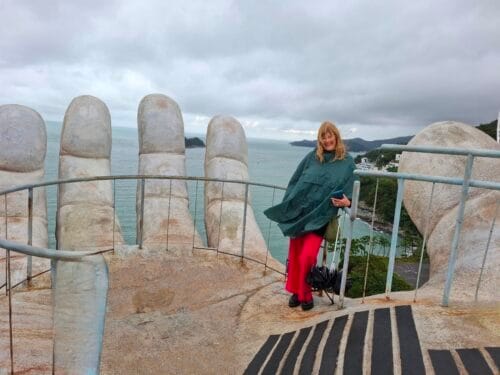
Of course, the star is the Hand of Midas. A giant arm with a hand rising above the sea, famous on Instagram and far more popular than the park itself. Normally, visitors queue for more than an hour to climb it. We were lucky — no lines, just the sound of the ocean below and the strange beauty of standing in a palm that once belonged to a mythical king.

The park turned out to be a hidden gem.  Quirky and confusing, yes — but in the best way possible. It had that mix of odd sculptures and unexpected views that you don’t find in guidebooks, and that’s what made it special for us. While most people only come for the famous Hand of Midas, the rest of the park had its own quiet charm.
There are even more “trick art” museums connected to the complex — the kind of playful, optical-illusion galleries that Korea is known for. We skipped them this time, but if you enjoy that style, you’ll find plenty here to keep you entertained.
Practical Info
 Practical Info
 Getting there: Art Land is about 20 minutes by car from central Yeosu. Parking is available almost at the entrance.
 Tickets: Available on-site or via Klook. Booking ahead saves time.
 Opening hours: Daily, usually 9:00–18:00 (check locally, times may vary).
 Stay: The resort connected to the park offers rooms with sea views — a more comfortable option than Yeosu’s city hotels.
 Tip: If you want photos on the Hand of Midas, arrive early or on a rainy day — the lines can be long.
Not many people outside the Netherlands or Korea know the name Hendrik Hamel. He was a Dutch sailor of the VOC who shipwrecked off Jeju Island in 1653. He and his crew were taken inland, kept under watch, and ended up living in Korea for thirteen years before they managed to escape. When Hamel finally returned home, he wrote down his story — a kind of 17th-century travel blog — which became one of the first detailed accounts of Korea in Europe.
Walking into the Hamel Memorial Museum, I didn’t expect much. But inside I found his logbook carefully displayed, and a friendly Korean guide who, in his best English, proudly explained the story. It was simple, almost modest, yet it carried weight. History suddenly felt close, as if the walls themselves remembered. It was so well maintained en there were no other visitors. Finding a bit of the Netherlands was a big surprise.
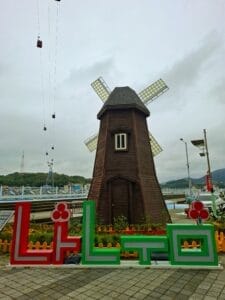
Outside, a lighthouse stands as a symbol of Hamel’s long journey, and even a Dutch-style windmill nods to his home country. For a moment, it felt like standing in two worlds at once: Korea by the sea, and traces of the Netherlands carried across centuries.
What makes it even more special: Hamel’s story is remembered on both sides. In his hometown Gorinchem, you can visit the Hendrik Hamel Museum — a small but fascinating place that keeps his memory alive from the Dutch perspective.
And perhaps it’s no coincidence. Korea has a curious habit of recreating pieces of the world within its borders. You’ll find German villages, French cafés, and even “European streets” built for visitors. Sometimes it feels a little artificial, but it also shows Korea’s fascination with other cultures — and how those cultures, in turn, see Korea.
Practical Info
Getting there: The Hamel Museum is located in Yeosu, easy to reach by car or local taxi. Tickets: Entry is free (which is very appealing to Dutch travelers 😊) Opening hours: Typically 9:00–18:00 (closed Mondays, check locally for updates). Tip: Combine with a walk along the waterfront for views of the lighthouse and the symbolic windmill.
After that glimpse of history, we wanted something different. A change of air, a change of color. Not long after, the road took us into rolling hills, soft mist, and endless lines of green: the tea plantations. 🍵
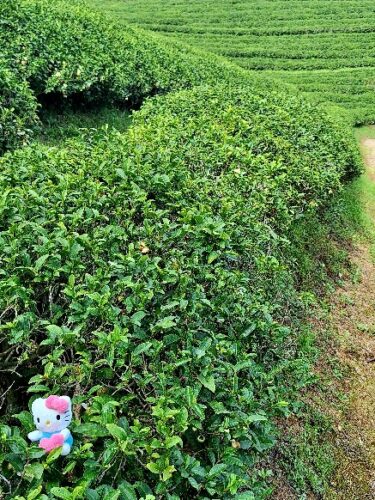
At first glance, the fields look endless, perfect for photos — waves of green disappearing into the mist. But the truth is that only small pockets remain. Most of Korea’s tea plantations have disappeared over time, leaving just a few carefully kept areas for visitors. That explains why they feel so photogenic: the neat rows are more like stage sets than vast farmlands.
Even so, the atmosphere was calming. Walking among the plants, smelling the faint bitterness of fresh leaves, it felt like time had slowed down. It wasn’t about the size of the fields, but about that rare mix of quiet and color.
Even next to the fields, there’s a small Tea Museum. It promises stories about Korea’s tea culture and the history of these plantations. Unfortunately, when we arrived it was closed — another reminder that these places aren’t run on big tourist schedules. Still, even from the outside it added to the atmosphere: a quiet building tucked between the green rows, almost like part of the scenery.
ℹ️ Practical Info
🚗 Getting there: The most famous site is Boseong Green Tea Plantation, about 1.5 hours from Yeosu by car.
🎟️ Tickets: Entrance around 4,000 KRW (about €3).
⏰ Opening hours: Generally 9:00–18:00, but best visited in the morning when mist still hangs in the hills.
📷 Tip: Even if the fields are smaller than expected, they are perfect for photos — soft light and rolling hills make it feel like a painting.
