


🏜️ Exploring Sossusvlei and Deadvlei
A calm traveller’s guide to Namibia’s most iconic desert landscape.
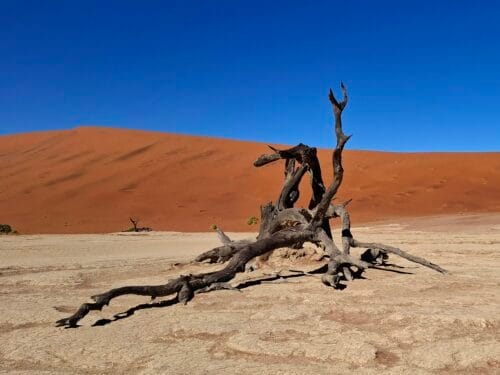
The drive to Sossusvlei feels like crossing into another world. The asphalt fades, the air dries, and the landscape turns from scrubland to deep red sand. There are no fuel stops, no quick snack breaks — just long gravel roads, sharp sunlight, and the sound of your own tires.
As you near Sesriem Gate, dunes rise higher, the light shifts by the minute, and the desert seems to breathe. Here you’ll find the famous Dune 45, the ghostly trees of Deadvlei, and the ancient Sesriem Gorge — proof that even in a place this dry, history still flows.
This guide leads you calmly through the essentials: where to stop, what to see, and how to enjoy Sossusvlei without rushing.
Planning to explore Namibia’s red desert?
Here’s a calm route through Sossusvlei, from the gate to the dunes — with quiet stops, practical tips, and Travelglaze comfort along the way. 🏜️
Explore this guide:
Before you reach the famous salt pans of Sossusvlei, you first enter the vast Namib-Naukluft National Park — one of Africa’s largest and oldest protected areas. 🏜️ It stretches from the Atlantic coast deep into the desert interior, covering nearly 50,000 km² of dunes, gravel plains, and dry riverbeds. Despite the heat, life survives here: springbok and oryx graze between the dunes, and tiny geckos 🦎 leave perfect zigzag trails behind.
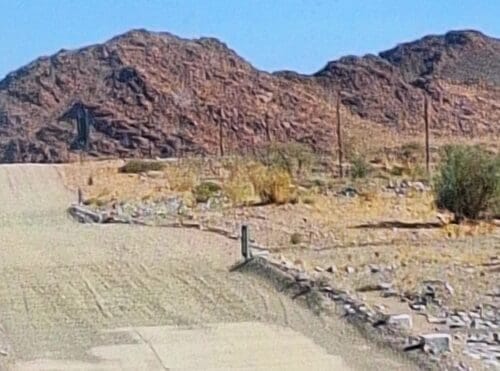
The park was created to protect the Namib Desert, often called the world’s oldest desert, and the rugged Naukluft Mountains ⛰️ that form its eastern border. Those cliffs hide freshwater springs and even mountain zebras — proof that water and life still exist on the edges of this harsh landscape.
Your first stop is Sesriem, a small, dusty settlement that acts as the park’s main gateway. ⛽ It has one fuel pump, a few lodges and campsites, and the permit office where you buy your park entry (2025: ≈ N$150 per person + N$50 per vehicle, valid 24 h).
This is also your last chance to refuel, stock up on water and snacks, and check your tires before heading inside the park — once past the inner gate, there are no shops or facilities.
⛰️ Sesriem Canyon – Before the Gate
Just a few kilometres before the main park entrance lies Sesriem Canyon, carved by the Tsauchab River millions of years ago.
It’s about 4 km from the permit office, easily reached by car, and takes around 30–45 minutes to explore on foot. The canyon drops up to 30 metres deep, offering shade and striking rock layers that tell the story of ancient floods. 🌄
Because it’s outside the inner gate, you can visit it any time of day — ideal if you’re waiting for cooler light or if the dunes are still closed.
💡 Travelglaze tip
Best time: early morning or late afternoon for softer light.
Bring sturdy shoes 👟; sand and loose stones make the descent slippery.
Stop here before or after your dune visit — it’s quieter and cooler than the open desert.
Just past the permit office, you’ll reach the Sesriem Gate — the true entrance to the Sossusvlei area. ⛩️
If you ever see a traffic jam in Namibia, it’s probably here. Before sunrise, cars line up quietly, waiting for the ranger to lift the barrier. Once the gate opens, headlights stream into the desert — everyone chasing that golden first light. 🌅
The 60-kilometre gravel road that follows is one of Namibia’s most surreal drives. 🏜️ Smooth black tar cuts through shifting red dunes, with springbok and oryx crossing now and then. The landscape changes constantly: low sand hills near the entrance, then higher, sharper ridges as you go deeper into the park.
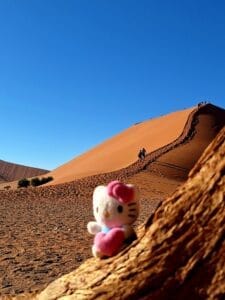 About halfway, a sign points to Dune 45 — the most photographed red dune in the Namib. 📸
It stands roughly 170 metres high and is named for its distance from the gate (45 km). Most visitors stop here just after sunrise to climb the ridge, where the view stretches over a sea of glowing sand. The climb takes 20–30 minutes; the descent, much faster and softer. Bring water and light shoes — the sand heats up quickly after 9 a.m.
💡 Travelglaze tip
Good stops along the main park road:
Elim Dune Viewpoint – just inside the gate, perfect for sunset.
Dune 23 Viewpoint – early-morning light, few visitors.
Dune 45 itself – climb before 8 a.m. for shade and softer sand.
The road continues toward Deadvlei and Sossusvlei, ending at a 2×4 parking area. From there, only 4×4 vehicles can continue through the soft sand for the final 5 kilometres. Don’t have one? No problem — a shuttle service 🛻 runs all day
🚐 How the Sossusvlei Shuttles Work
Where: The shuttle area is at the end of the 60 km asphalt road, near the 2×4 parking.
When: They start running around sunrise and continue until late afternoon (usually until 16:30).
Price: About N$180 return per person — cash only is safest. 💵
Duration: ± 10 min each way. The shuttle drops you off first at Deadvlei, then at Sossusvlei proper, and returns on rotation.
Comfort: Expect open 4×4 trucks with benches; bring a scarf or hat for the wind and sand. 🧢
Tip: Keep your ticket — it’s needed for the ride back.
Most travellers stop at Dune 45 and rush straight to Deadvlei — but just before the final shuttle area, there’s a quieter stretch of desert that’s easy to overlook. 🏜️ Wind and erosion have carved small gorges and dry riverbeds here, where the sand gives way to stone. It’s a landscape that shows how the desert keeps changing, slowly cutting deeper into the earth each year.
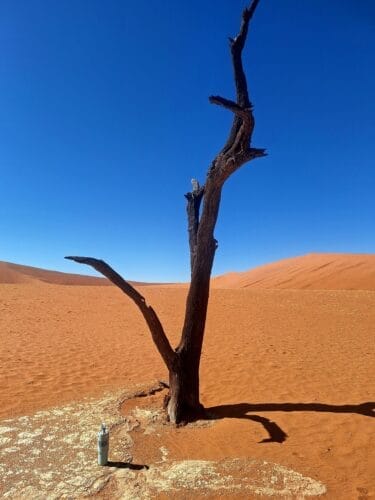
Scattered among the low ridges are several petrified trees 🌳 — fossilised remains of ancient wood, long turned to stone by minerals in the sand. They’re harder to spot than the blackened trees of Deadvlei, but the shuttle drivers can point them out if you ask. A short walk gives you a rare glimpse of the desert’s deep history — a reminder that Sossusvlei wasn’t always this dry.
💡 Travelglaze tip
Ask your 4×4 or shuttle driver 🛻 to stop briefly near the petrified-tree zone, just before Deadvlei.
Visit early morning or late afternoon for the best light and cooler air. 🌅
Keep your shoes on 👟 — even short walks in the sand can burn your feet after midday.
Even though most travellers use the names interchangeably, Sossusvlei and Deadvlei are actually two different places — close to each other, but not the same.
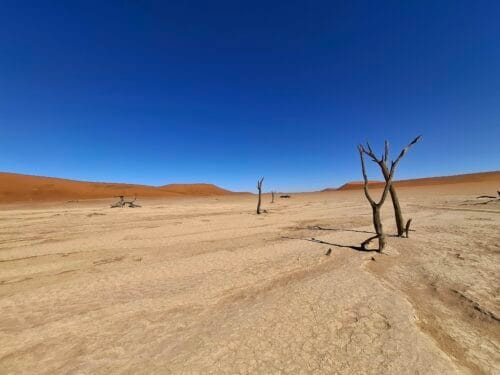
Sossusvlei 🌵 is the broader clay pan at the end of the Tsauchab River — the point where water sometimes collects after rare heavy rains. The word “vlei” means “marsh” in Afrikaans, although it’s usually bone-dry. The surrounding dunes are some of the highest in the world, reaching over 300 metres.
Deadvlei 🌳 lies nearby, separated by one large dune. Long ago, the river shifted and cut it off completely, leaving behind hundreds of dead camel thorn trees that dried out and hardened under the sun. The white clay pan, the black trees, and the red dunes make it one of the most photographed places in Africa.
💡 Travelglaze tip
If you only have time for one, choose Deadvlei for the unique contrast and photography, but stop at Sossusvlei proper if you want to see how rare rainfall shapes life in the desert.
Leaving the park behind, the desert opens up again — wide, silent, and endless. 🏜️ After the red dunes fade into pale gravel, the next sign of life is Solitaire, a tiny outpost about 80 kilometres north of Sesriem on the C19.
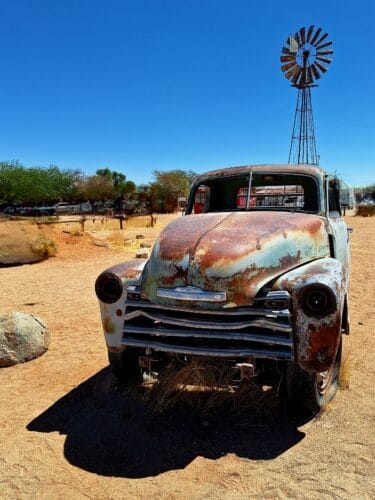
It’s hard to call it a village. Solitaire is little more than a fuel pump ⛽, a small bakery, and a few weathered buildings surrounded by rusted vintage cars half-buried in the sand. These old Chevrolets and Fords have become one of Namibia’s most photographed roadside scenes — a mix of nostalgia and survival that fits perfectly with the emptiness around it. 📸
Despite its size, Solitaire has everything you need for a short stop or even a night’s rest. 🏠 The Solitaire Lodge and nearby campsite are peaceful and practical — one of the few places where you can actually sleep under the desert sky without another light in sight. 🌌 In the early morning, locals sometimes spot meerkats (or small ground squirrels) 🐿️ near the edge of the settlement, though they stayed hidden during my visit.
Most travellers, however, come here for Moose McGregor’s Desert Bakery, home of the “world-famous” apple pie. 🥧 It’s warm, cinnamon-rich, and slightly spongy — the kind of dessert that tastes like adventure and dust at the same time. For Dutch visitors, it might not quite beat a slice of homemade appeltaart, but it’s still part of the Namibia experience.
💡 Travelglaze tip
📍 Location: Along the C19, 80 km from Sesriem — the only reliable fuel stop before heading north.
⏱️ When to stop: Late morning after your Sossusvlei visit or overnight en route to Swakopmund or Walvis Bay.
🏠 Stay overnight if you prefer not to rush; rooms are simple but comfortable.
🥧 Try the pie, snap a photo, and stretch your legs — there’s nowhere else quite like it.
🌄 Final Thoughts
Sossusvlei isn’t just about the dunes — it’s about scale, silence, and the strange beauty of nothingness.
Every kilometre feels different: black rock near Sesriem, golden ridges along the road, and that unreal white pan at Deadvlei where time seems to have stopped. 🏜️
The long drives, the early mornings, the heat — they all add to the rhythm of this place. Once you’ve brushed the red sand off your shoes and left the desert behind, it’s hard not to look back. Even the road to Solitaire, with its old cars and sweet scent of apple pie 🥧, feels like part of the story — a reminder that comfort and wilderness can exist side by side. 
If Namibia teaches you anything, it’s patience. The desert moves slowly, and so should you.
💡 Travelglaze tip
Planning a longer route through Namibia? Continue your journey north to Windhoek — the country’s capital and cultural heart, where colonial history and modern creativity meet.
