Maeklong Railway Market: Train Schedule, How to Visit & Travel Tips

A practical guide to visiting Thailand’s famous train market near Bangkok

by Kitty

Maeklong Railway Market: When a Train Passes Through a Market

What happens when a train runs straight through a market?

The Maeklong train driving through the daily market

At the Maeklong Railway Market, the railway tracks run directly through the middle of a busy market street filled with food stalls, local products and souvenir stands. Vendors sell everything from snacks and fruit to grilled seafood and tourist souvenirs, while travellers wait for the moment everyone has come to see.

🚆 Several times a day a train slowly approaches the market. Within seconds stalls are pulled back, awnings are folded away and the crowd steps aside as the train passes only centimetres from the market stands.

When the last carriage disappears, the stalls slide back into place and the market continues as if nothing happened.

🚆 What makes this place remarkable is that it is not a staged attraction. Maeklong is still a functioning market where locals buy fresh food and everyday products.

📍 At the same time it has become one of the most curious places to visit just outside Bangkok — a place where daily life and travel curiosity meet on the same narrow railway track.

Jump to:

Some links in this article are affiliate links, shared as practical options to keep planning simple.

THe maeklong railway track and the people who wear elephant pants

One question visitors often ask is why the market never moved when the railway was built.

There is no dramatic legend behind it. The explanation is likely much simpler.

When the railway line to Mae Klong was constructed in the early 20th century, the local market was already operating in the same area. Moving an entire market would have meant relocating dozens of vendors and risking the loss of regular customers.

🛤️ Instead of relocating, the vendors adapted. They learned to quickly pull back their goods, fold their awnings and clear the tracks whenever a train approached. Within minutes everything could be set up again.

Over time this routine became part of the rhythm of the market, giving it the Thai nickname Talad Rom Hub, often translated as “the market where the awnings fold down.”

🚆 The railway itself is also a little unusual. The Mae Klong Railway is not one continuous train line from Bangkok. Travelling the full route involves two short train rides with a river crossing in between — something that surprises many visitors who try the journey for the first time.

📍 What began as a practical solution for local vendors eventually turned the Maeklong Railway Market into one of the most unusual market scenes in Thailand — a place where everyday commerce and a passing train share the same narrow street.

Train schedule at Maeklong Railway Market

The most important thing to know before visiting the Maeklong Railway Market is that the train does not pass constantly. It only runs a few times a day, which means timing your visit makes a big difference.

🚆 The train passes through the market eight times a day — four arrivals and four departures at Mae Klong station.

Arrivals at Mae Klong station

  • 🚆 08:30

  • 🚆 11:10

  • 🚆 14:30

  • 🚆 17:40

Departures from Mae Klong station

  • 🚆 06:20

  • 🚆 09:00

  • 🚆 11:30

  • 🚆 15:30

📍 If you want to see the market transform when the train approaches, try to arrive 20–30 minutes before one of the arrival times, when most visitors gather along the tracks.

⚠️ Train schedules can occasionally change, so it is wise to check the latest timetable .

Where to stand when the train passes

When the train approaches the Maeklong Railway Market, many visitors gather along the railway tracks to watch the moment the market transforms.

📸 A good place to stand is close to one of the market stalls along the track. Many vendors stretch a small chain or rope across the front of their stall. Visitors are often allowed to stand just behind this line.

💡 This is actually a helpful signal. If you stand behind the chain, you know you are in a safe spot and not blocking the vendors while they quickly move their goods away from the tracks.

🚆 When the train passes, it moves extremely close to the market stalls — sometimes only a few centimetres away. Standing behind the stall boundary gives you a good view while staying out of the train’s path.
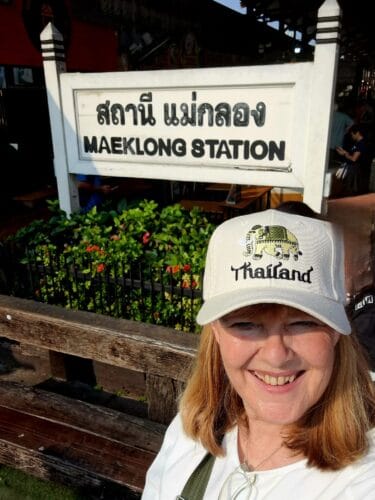
Me standing before the railwaystation sign with a souvenir cap

How to get to Maeklong Railway Market from Bangkok

The Maeklong Railway Market is located in the town of Mae Klong in Samut Songkhram province, about 70 kilometres southwest of Bangkok. Depending on how you travel, the journey usually takes about 1 to 1.5 hours.

There are several ways to reach the market.

🚆 By train (the scenic route)

Travelling by train is the most unusual way to reach the market, but it is not a direct journey.

The route is part of the Mae Klong Railway, which is split into two separate train lines with a river crossing in between.

The journey works like this:

🚆 Bangkok (Wongwian Yai Station) → Mahachai
Take the local train from Wongwian Yai station to Mahachai. The journey takes about one hour.

⛴️ Mahachai → Ban Laem
From Mahachai station you walk a few minutes to the pier and take a short ferry across the Tha Chin River.

🚆 Ban Laem → Mae Klong
After crossing the river you take a second local train from Ban Laem station to Mae Klong station, which is located right at the end of the market.

🎟️ Tickets for the Mae Klong Railway are very simple to arrange. These are local trains and tickets are usually bought directly at the station shortly before departure. There is normally no reservation system and seats are unassigned.

💡 This route is inexpensive and interesting, but it requires several changes and some patience. Many travellers enjoy it as a small adventure rather than the fastest way to reach the market.

🚐 By taxi or Grab

The easiest way to visit the market from Bangkok is by taxi or Grab.

🚗 Travel time: about 1 to 1.5 hours, depending on traffic.

This option allows you to arrive shortly before one of the train times and avoid the longer train journey.

🚌 By organised tour

Many day tours from Bangkok combine the Maeklong Railway Market with the nearby Amphawa Floating Market or the Damnoen Saduak Floating Market.

📍 This can be convenient if you prefer a guided visit, although tours often arrive at the same time.

Is it worth taking the train to Maeklong Railway Market?

Many travellers wonder whether it is worth taking the train to the Maeklong Railway Market itself, rather than just watching it arrive.

🚆 The experience can be interesting, because the train passes slowly through the narrow market street before stopping at Mae Klong station at the end of the tracks. From inside the train you see stalls, awnings and visitors very close to the windows.

However, the view from the train is actually quite limited. Most of the spectacle happens on the platform and along the market stalls, where vendors quickly pull back their goods and visitors gather to watch the train pass.

📸 For many travellers it is therefore more enjoyable to stand in the market and watch the train arrive or depart, rather than sitting inside it.

💡 In the end it really depends on what kind of traveller you are. If you enjoy unusual train journeys and local transport, riding the train into Mae Klong can be a fun part of the experience. The route from Bangkok is a bit more complicated than it first appears and involves changing trains and crossing a river by ferry along the way.

📍 But if your main goal is simply to see the famous railway market moment, watching the train pass through the market itself is perfectly enough.

🧭 A Travelglaze Moment — Visiting from Amphawa

I visited the Maeklong Railway Market while staying in nearby Amphawa, which is only about ten minutes away by taxi. Compared to the longer trips many travellers make from Bangkok, it felt more like a short local outing.

THe maeklong railway track and the people who wear elephant pants🚕 I arrived about twenty minutes before the train, and the first thing that struck me was the crowd. The narrow market street was packed with visitors waiting for the train, many wearing the famous elephant pants — probably the most common souvenir you see in Thailand. Cameras were ready everywhere as people searched for the perfect spot.

As the train time approached, everyone slowly moved closer to the tracks. What surprised me was how calm and organised everything felt. The vendors quietly pointed people to safe places near their stalls, sometimes stretching a small chain in front of their goods so visitors knew where to stand.


🚆 Then the train appeared and slowly rolled through the market. It only takes a few minutes, but it is a strange and memorable sight to see a train passing so close to the market stalls.

The most interesting moment actually came afterwards. As soon as the train had passed, many visitors hurried after it along the tracks, trying to follow the train and hurrying back to their tour busses.

📍 Suddenly the market became much quieter. With most tourists gone, you could see how the market normally works: locals buying vegetables and seafood, vendors reopening their stalls and chatting with regular customers. For me, that was the moment when the visit became much more interesting, because I finally had time to walk around and really look at the stalls.

And no — I did not buy elephant pants.

🚌 One more practical detail: from Mae Klong there is also a bus station with direct buses back to Bangkok, which can be a convenient way to continue your journey.

Different types of markets in Thailand

The Maeklong Railway Market is one of the most unusual markets in Thailand, but it is certainly not the only kind of market you may encounter while travelling through the country.

Markets are an important part of daily life in Thailand, and many have developed their own character depending on location, culture and local traditions.

🚆 Railway markets
Markets built along active railway tracks are extremely rare. Maeklong is the best-known example, where vendors have learned to quickly move their stalls whenever a train approaches.

🛶 Floating markets
In areas with many canals, markets developed on the water. Vendors sell fruit, vegetables, snacks and cooked food directly from small boats. Famous examples include Amphawa and Damnoen Saduak.

🌙 Night markets
In many Thai cities, markets come alive after sunset. Night markets usually focus on street food, snacks, clothing and souvenirs, and they often have a lively social atmosphere.

🏘️ Local fresh markets
Across Thailand you will also find traditional fresh markets where locals buy vegetables, fish, meat and everyday products. These markets are usually busiest early in the morning.

📍 Each type of market offers a different experience, but together they show how central markets are to everyday life in Thailand.

Final Thoughts — Visiting the Maeklong Railway Market

The Maeklong Railway Market shows how everyday places can unexpectedly become travel highlights. What started as a practical local market gradually turned into one of the most curious stops near Bangkok.

What makes it interesting is the contrast: a working market where locals still shop for vegetables and seafood, while visitors from all over the world gather to witness a moment that only lasts a few minutes.

📍 If you decide to visit, take some time to walk through the stalls instead of leaving immediately. Once the crowds move on, the market reveals a quieter side that feels much closer to daily life in this small Thai town.

💬 Would you visit the Maeklong Railway Market just to see the train pass, or would you stay longer to explore the market itself? I’d love to hear how you would approach this unusual place.


Leave a Comment

You may also like

Travelglaze
Blog about travelling the world with wonder - for the somewhat older people