Is Thailand Cheap and Safe for Travellers? 30 Truths and Myths

30 common travel assumptions about Thailand explained

by Kitty

🔍 Thailand: Truth or Myth — 30 Things Visitors Often Get Wrong

Before you travel to Thailand, you probably hear a lot of things.

You prepare by reading blogs, scrolling through travel websites, checking guidebooks, watching videos. But most impressions often come from conversations — friends who went once, someone who lived there years ago, a story that keeps getting repeated.

Thailand is one of those destinations that seems familiar even before you arrive.
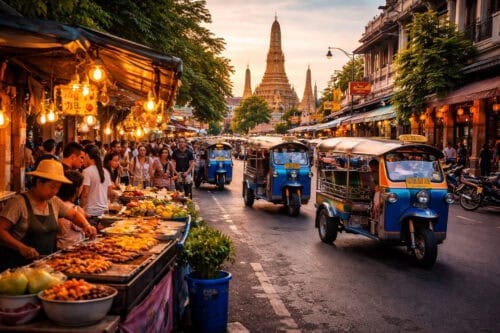
typical streetlife in Bangkok - Thailand. Food, temples and tuktuksIt’s described in quick statements. Short conclusions. Confident advice.

Some of it is helpful. Some of it is outdated. Some of it depends entirely on where you go and how you travel.

So how much of what we “know” about Thailand is actually true?

Let’s take a closer look, or jump straight to the section that interests you.
Money & Prices
Food & Drink
Culture & Etiquette
Getting Around & Safety
Weather, Regions & Expectations

💸 Money & Prices

Money is often the first thing people talk about when it comes to Thailand. Is it still cheap? Has it become expensive? Do you need to negotiate everything?

The answer is rarely simple. It depends on where you go, how you travel and what you compare it to.

Let’s start with the basics.

Thailand is still a €20-a-day destination.

For years, Thailand was described as the ultimate backpacker bargain. Stories of ultra-cheap guesthouses and meals for a few euros still circulate.

❌ Myth

While Thailand can still be affordable, €20 a day is no longer realistic for most travellers in 2026. Accommodation standards have improved, transport costs have risen and popular destinations charge accordingly. You can travel on a budget — but expectations need updating.

Some islands are significantly more expensive than the mainland.

If you compare prices between northern Thailand and well-known islands, you will notice a clear difference.

✅ Truth

Accommodation prices on islands often reflect transport logistics and demand. Flights, ferry routes and limited land space drive up costs. Even simple beach bungalows can cost more than a comfortable city hotel inland. Koh Samui, Phuket and parts of Krabi can feel very different price-wise compared to northern Thailand.

You need to bargain everywhere.

Many travellers arrive in Thailand expecting to negotiate every price — from taxis to coffee to souvenirs.

❌ Myth

Bargaining is common in traditional markets and some tourist areas, but it is not universal. Shopping malls, convenience stores, restaurants and many shops have fixed prices. Even in markets, polite and light negotiation works better than aggressive haggling. In modern Thailand, bargaining culture is more situational than automatic.

ATM withdrawals always come with fees.

You may hear that getting cash in Thailand is expensive because of bank charges.

✅ Mostly true

Most Thai banks charge a fixed withdrawal fee for foreign cards, regardless of the amount you take out. This makes larger withdrawals more economical than frequent small ones. Your home bank may add its own fees as well. ATMs are widely available — but not free for international visitors.

Street food is cheaper than restaurant food.

sign of streetfood PadThaiThailand is famous for inexpensive street meals, often described as the cheapest way to eat.

⚖️ It depends

Local street stalls serving simple dishes are often cheaper than restaurants. However, trendy night markets and tourist-focused food areas can charge prices similar to casual restaurants. Location matters. A plate of pad krapow in a residential neighbourhood may cost half of what you pay in a popular beach area.


Credit cards are accepted everywhere.

With shopping malls and international chains widely available, it can feel like Thailand is fully card-friendly (2026).

❌ Myth

Credit cards are accepted in hotels, larger restaurants and malls — especially in cities and tourist hubs. But many local eateries, markets and small guesthouses still operate on cash. In smaller towns and on some islands, cash remains essential. Having a mix of payment options prevents small frustrations.

Taxis always overcharge tourists.

Stories about taxi scams circulate quickly among travellers.

❌ Myth

Many taxis operate honestly and use the meter without issue — especially in cities like Bangkok when you ask for it. In tourist-heavy areas, some drivers may refuse the meter or quote a fixed price instead. Confirming “meter?” before entering a regular taxi also prevents most misunderstandings.

Experiences vary — it is not a nationwide pattern.

Ride-hailing apps like Grab and Bolt are widely used in Thailand these days and often make pricing clearer upfront. 

💡 Money in Thailand is less about “cheap or expensive” and more about expectations. The country can still suit many budgets — but assumptions from ten years ago no longer apply everywhere.

🍜 Food & Drink

Thai food is one of the main reasons people travel to Thailand. It is praised, feared, romanticised and simplified — often at the same time.

But how much of what we “know” about Thai food actually reflects daily reality?

Let’s look a little closer.

Pad Thai is the most authentic Thai dish.

For many visitors, Pad Thai becomes the symbol of Thai cuisine — the dish that defines the country.

❌ Myth

Pad Thai is popular and widely available, but it is not the most traditional or representative dish across Thailand. It became globally famous partly due to tourism and national promotion. In everyday Thai households, dishes like curries, stir-fries or soups are often far more common than Pad Thai.

Street food is unsafe.

You may hear warnings that eating from roadside stalls is risky.

❌ Myth

Street food is a normal part of daily life in Thailand. Many vendors specialise in one dish and prepare it fresh throughout the day. High turnover often means ingredients do not sit around for long. As anywhere, choosing busy stalls and observing hygiene practices helps — but street food itself is not inherently unsafe.

Ice in drinks is unsafe.

Some travellers automatically refuse ice, assuming it is made from tap water.

❌ Myth

In most urban and tourist areas, ice is commercially produced in filtered facilities and delivered in sealed bags. It is widely used by locals as well. The risk is generally lower than many assume — especially compared to untreated tap water.

Thai people don’t eat breakfast like Westerners do.

Visitors sometimes expect toast, cereal and coffee as the norm.

⚖️ It depends

Traditional Thai breakfast often includes savoury dishes such as rice soup (jok), grilled pork with sticky rice or leftover dishes from dinner. However, urban areas now offer a wide mix of Thai and Western-style breakfast options. What you see depends largely on region and setting.

Mango sticky rice is a seasonal dessert.

Visitors often see mango sticky rice everywhere and assume it is eaten year-round.

✅ Truth

Traditionally, mango sticky rice is linked to mango season, which typically peaks between March and May. Outside that period, availability depends on imported or greenhouse-grown mangoes. In tourist areas it may appear constant — but seasonality still matters in local markets.

Thai dishes are meant to be shared.

In many Western countries, everyone orders an individual plate.

✅ Truth

In Thailand, meals are often shared. Several dishes are placed in the centre of the table and eaten together with rice. This reflects balance — different flavours complementing each other rather than one dominant dish per person. In tourist restaurants you can order individually, but shared dining remains culturally common.

🍜 Thai cuisine is shaped by season, region and shared dining traditions. What travellers often see first is only one layer of a much broader food culture. Even colour plays a role — from green curries to golden turmeric dishes — something we explored further in  the meaning of colours in Thailand.

🛕 Culture & Etiquette

Thailand is often described as polite, gentle and respectful. But many cultural rules are more layered than they first appear.

Some behaviours are misunderstood. Others are simplified. And a few depend entirely on context.

Let’s look at what actually applies.

The wai is just a polite greeting like a handshake.

Visitors often compare the wai to a Western handshake — a standard greeting between equals.

❌ Myth

The wai reflects hierarchy and respect. The height of the hands and the depth of the bow depend on age and social position. Younger people wai first to elders, and service staff often initiate it toward customers. It is not simply “hello” — it communicates relationship.

Pointing your feet at someone is disrespectful.

You may hear that your feet are considered the lowest and least respectful part of the body.

✅ Truth

In Thai culture, feet are symbolically low, while the head is considered high. Pointing your feet at someone, resting them on tables or directing them toward Buddha images is seen as impolite. This is especially relevant when sitting on the floor in temples or traditional homes.

Modest clothing is expected in temples.

Travellers are often told to cover shoulders and knees when visiting temples.

✅ Truth

While enforcement varies, modest clothing is widely expected in Thai temple spaces. Shoulders and knees should be covered, and beachwear is considered inappropriate. At major temples and royal sites, staff may refuse entry if you are underdressed. Smaller neighbourhood temples can be more relaxed — but respectful clothing is always appreciated.

Monks are not allowed to touch women.

You may hear that any contact between monks and women is strictly forbidden.

⚖️ It depends

In Theravada Buddhist tradition, monks avoid physical contact with women as part of their discipline. Women are not supposed to hand objects directly to monks; items are usually placed on a cloth or surface instead. However, accidental contact in public transport or crowded areas is not treated as scandalous drama — it is simply avoided where possible.

You can take photos anywhere inside a temple.

With phones constantly in hand, it is easy to assume photography is always acceptable.

❌ Myth

Many temple grounds allow photography, but some interiors restrict it — especially where sacred relics or active worship are taking place. Signs are usually visible. Even where photos are allowed, respectful behaviour matters more than the perfect angle.

Public confrontation is generally avoided.

Visitors sometimes expect directness or open disagreement in everyday interactions.

✅ Truth

In Thai culture, maintaining composure and social harmony is highly valued. Open confrontation or raised voices in public are usually avoided. Disagreements tend to be expressed more subtly or handled privately. This does not mean problems do not exist — but the way they are communicated often feels calmer than in many Western settings.

Removing your shoes is only required in temples.

Most visitors associate shoe removal strictly with religious spaces.

❌ Myth

Shoes are removed in temples, but also in many homes, some shops, guesthouses and even certain offices. If you see a pile of shoes at the entrance, that is your cue. It is a sign of cleanliness and respect rather than religion alone.

🙏 Respect in Thailand is often expressed quietly. Understanding a few social cues makes everyday interactions smoother and more comfortable for everyone involved.

🚕 Getting Around & Safety

Transport and safety are often discussed together when people talk about Thailand. Stories travel fast — especially dramatic ones.

But how much reflects everyday reality?
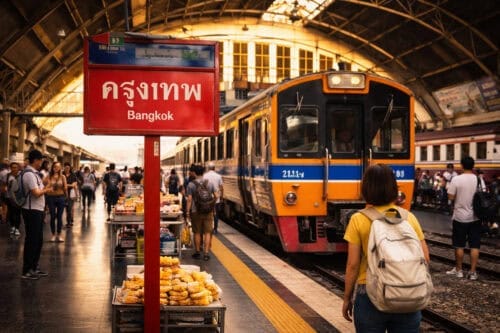
Trainstation in Bangkok

Domestic flights are always the fastest option.

When distances look large on the map, flying seems like the obvious choice.

⚖️ It depends

Flights can save time on long routes, but airport transfers and waiting times reduce the advantage. On certain routes, overnight trains or direct buses can be just as efficient — and sometimes more relaxed. Speed depends on the entire journey, not only the time in the air.

Songthaews work like regular taxis.

Many travellers assume they operate the same way as metered taxis.

❌ Myth

Songthaews usually follow semi-fixed routes and function more like shared transport. In tourist areas they may act more like informal taxis, but pricing systems vary widely. Understanding how they operate locally prevents confusion.

You need an international driving licence to rent a scooter.

Some travellers believe paperwork is optional.

✅ Truth

Legally, an international driving permit is required to ride motorbikes in Thailand. Rental shops may not always enforce this, but police checks are common in tourist areas. Without the proper licence, insurance can be invalid in case of an accident.

Road accidents are a bigger risk than crime.

Safety discussions often focus on scams or theft.

✅ Truth

Statistically, road accidents — especially involving motorbikes — pose a greater risk to travellers than violent crime. Thailand has high traffic accident rates compared to many European countries. Careful driving and helmet use matter more than worrying about street crime.

Thailand is a safe destination for solo travellers.

Thailand is often recommended for people travelling alone.

✅ Mostly true

For many solo travellers, Thailand feels approachable and welcoming. Public transport is easy to navigate, tourism infrastructure is well developed and English is widely spoken in major areas. As anywhere, awareness matters — especially in nightlife settings or on the road — but everyday solo travel is generally comfortable and manageable.

🌏 For many travellers — including solo visitors — Thailand feels manageable and welcoming. A little preparation goes further than worrying about worst-case scenarios.

🌦 Weather, Regions & Expectations

Thailand is often described in simple terms: hot, tropical, beachy. But the country stretches far north to south, with different climates, landscapes and rhythms.

Here is where expectations often need adjusting.

The rainy season often brings short, heavy showers rather than constant rain.

Many travellers imagine monsoon season as endless grey skies.

✅ Truth

In many parts of Thailand, the rainy season consists of intense but brief downpours, often in the afternoon or evening. Mornings can remain bright and humid. Travel remains possible, landscapes turn greener and popular destinations feel less crowded.

November to February is perfect everywhere in Thailand.

This period is widely promoted as the “best time” to visit.

⚖️ It depends

November to February is generally pleasant in many parts of Thailand, particularly central and northern regions. However, weather patterns differ between the Andaman Sea and the Gulf of Thailand. One coast may enjoy sunshine while the other experiences rough seas. “Best time” depends on where you plan to go.

The north of Thailand is cooler than the south.

Travellers often hear that heading north means escaping the heat.

✅ Truth

Northern Thailand, especially mountainous areas like Chiang Mai and Chiang Rai, can feel noticeably cooler — particularly in the cool season. Evenings in December and January may require a light jacket. The south, by contrast, remains consistently warm and humid year-round.

Bangkok is chaotic everywhere.

Many first impressions focus on traffic and noise.

❌ Myth

Bangkok has chaotic districts — but it also has quiet neighbourhoods, riverside communities and green spaces. Areas vary significantly. What feels overwhelming near major transport hubs can feel surprisingly calm a few streets away.

🌍 Thailand is more varied than its postcard image suggests. Climate, regions and atmosphere shift more than many first-time visitors expect.

✨ Final thoughts — truth, myth and everything in between

Thailand rarely fits into one sentence.

It can feel affordable — until you reach a popular island.
It can feel calm — until you step into rush-hour traffic.
It can confirm what you heard — and quietly challenge it the next day.

many tourists on a tropical island in Thailand

That is not contradiction. It is context.

Many travel assumptions are not completely wrong. They are simply incomplete. Thailand is layered, regional and situational. The more you look beyond headlines and one-line advice, the more nuanced the experience becomes.

Instead of asking, “Is this true or false?”, it may be more helpful to ask, “Where does this apply?”

💬 Which assumption about Thailand surprised you most once you experienced it yourself?

Leave a Comment

You may also like

Travelglaze
Blog about travelling the world with wonder - for the somewhat older people