Hidden Crafts of Amsterdam

Guild houses, façade stones and today’s makers.

by Kitty

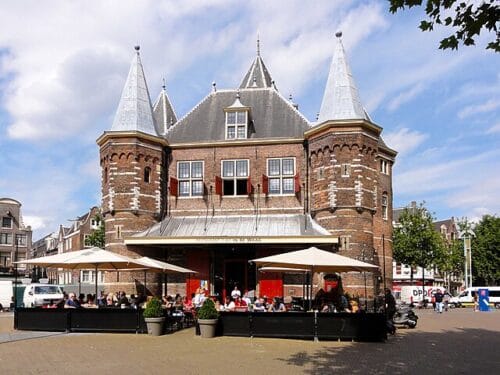
de waag - Amsterdam. A restaurant with a lot of history about guildesThe Lost Crafts of Amsterdam 🛠️✨

Most people walk past without noticing it.
The Waag — now a restaurant on the Nieuwmarkt — looks like a familiar historic building. Solid, decorative, part of the city’s background noise.

But if you pause for a moment, the façade starts telling a different story.

The building wasn’t always this calm. In the 15th century, when it was still the Sint Antoniespoort, this was the edge of Amsterdam. A fortified gate with towers that doubled as small prisons in peaceful times. When the city expanded at the end of the 1500s, the gate lost its defensive purpose, but not its importance.

In the 17th century, during the Golden Age, the structure became Amsterdam’s weigh house — the place where merchants had their goods weighed and taxed. Each craft guild received its own entrance, carved in stone. If you look closely at the front façade today, you can still spot a small sculpted figure holding a set of weights: one of the few visible reminders of the building’s commercial past.

But the most intriguing entrance is just left of the main doorway.
The steps here are noticeably more worn, rounded down by centuries of repeated use. A shallow groove runs through the stone — not from weather, but from wooden stretchers carried in and out of the building. This was the entrance of the Chirurgijnsgilde, the guild of early surgeons.

Behind these walls, and even in the vaulted cellars beneath your feet, the chirurgijns held public anatomical demonstrations. Not hidden from the city, but as official events — performed on bodies of executed criminals. It was here, in 1632, that Rembrandt painted his famous Anatomical Lesson of Dr. Nicolaes Tulp, capturing a moment that unfolded inside this very guild hall. 

Painting of Rembrandt: Anatomie Nicolas Tulp

Look at the windows on this side: they sit higher than they should.
They were placed that way intentionally, to let light in while keeping curious eyes out.

Later, in 1812, Amsterdam moved its guillotine to the Nieuwmarkt, turning the Waag into the backdrop of public executions. The last was carried out in 1854, long after the guilds were abolished and the building lost its official role.

Today it’s a restaurant.
But the stone hasn’t forgotten who once worked here — or what they left behind.

For more hidden corners and historical layers in Amsterdam, you might also enjoy these other blogs:

🗝️ Where to Find It Today

You don’t need a tour or a guide to see the traces of the Chirurgijnsgilde — they’re still visible on the outside of the Waag if you know exactly where to look.

🗺️ Location
Nieuwmarkt 4, Amsterdam

👀 What to look for

  • Stand in front of the main entrance.

  • Look left: the stone steps here are noticeably more worn than on the right.

  • Just above these steps, examine the stone blocks around eye level — this is where the guild’s entrance once was.

  • On the right side of the façade, spot the small sculpted figure holding a set of weights — a reminder of the Waag’s role as the city’s weigh house.

🔦 Extra detail
If the restaurant is open, step inside and look up: the interior layout still follows the original guild rooms. The vaulted cellars beneath the building — once used for public anatomical demonstrations — are not freely accessible, but their structure shapes the entire lower floor.

🕰️ Opening hours
The Waag operates as a restaurant. Hours vary; check their site before visiting.

💡 Travelglaze Tip
Visit the Nieuwmarkt at a quieter moment — before 10:00 in the morning or around 16:00. Fewer market stalls and bikes block the view at these times, so you can clearly see the worn steps, the high windows and the old guild entrances. For the best full view of the façade, stand on the edge of the square near Café Latei.

🔗 Related Amsterdam Story
If you enjoy places with layers of hidden history, you may also like Amsterdam ghost stories

🧱 Het Metselaarsgilde (Masons’ Guild)

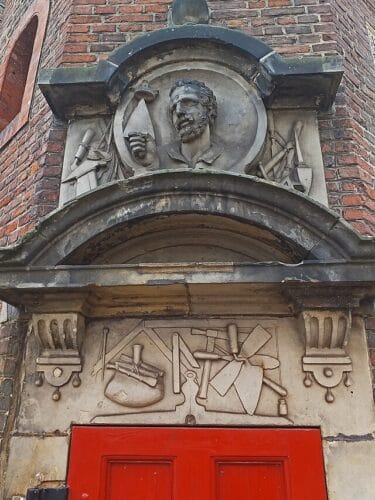
Not far from the Nieuwmarkt, the city starts revealing a different kind of craft — quieter, smaller, and easier to overlook. The masons of Amsterdam worked everywhere, yet almost none of their names survive. What remains instead are the marks they carved into brick and stone to identify their work.

Walk a little deeper into the old streets, and you may notice one of them without realizing what you’re looking at: a simple symbol, usually a shape or tool, placed just above a doorway. Some look like abstract lines, others like tiny hammers or chisels. Many are faded, but once your eyes catch the first one, the rest appear like hidden signatures scattered across the city.

One of the clearest examples sits a short walk from the Waag, along the narrow alleys leading toward the Kloveniersburgwal. Look closely at the older houses here and you’ll spot a small stone marker set into the façade — a mason’s stone. It was never meant as decoration. It was a practical sign, a way for masons to show which part of the building they worked on, long before building permits and inspection reports existed.

Most people pass these stones without seeing them. They blend into the brickwork, softened by centuries of weather, bicycles, renovations and new paint. But once you learn to recognise their shapes, Amsterdam changes. The houses gain authors. The walls gain voices. And the city becomes a place built not just by history, but by hands that wanted to leave something behind.

These stones are not rare — only hidden. And they are easy to visit on a short walk from the Waag.

Masonery guild stone in the waag - AmsterdamWhere to Find It Today 🗝️

You don’t have to go far to see real mason’s stones in Amsterdam — several are hidden in the streets just behind the Nieuwmarkt, all within a few minutes’ walk.

📍 Best area to spot mason’s stones

  • Kleine Koningsstraat

  • Koestraat

  • Barndesteeg (toward Kloveniersburgwal)

  • The alleys between Nieuwmarkt and Oude Hoogstraat

These streets contain some of the oldest surviving façades in the area.


🔍 What to look for

  • Small stones or blocks set into the façade

  • Shapes resembling tools (hammer, chisel, compass)

  • Simple geometric marks used as identity signs

  • Stones placed just above door height or near the corners of older buildings

🗺️ Most reliable example
On Koestraat, near the corner with Barndesteeg, you’ll find a clear mason’s stone embedded directly above a narrow doorway. It’s easy to miss because it blends into the brickwork, but once you see it, the shape stands out immediately.


🍇 Het Wijnkopersgilde (Wine Buyers’ Guild)

A few minutes from the Nieuwmarkt, the streets grow narrower and quieter. The noise fades, the houses lean in, and suddenly you stand in front of a façade that doesn’t behave like a normal Amsterdam house. At first glance it looks decorative — a little ornate, a little unusual — until your eye catches something carved into the stone that doesn’t belong to any modern city: a cluster of grapes, a small barrel, a symbol that seems older than the building surrounding it.

This is the Wijnkopersgildehuis, one of the clearest surviving traces of Amsterdam’s trading past. Here, wine buyers once gathered to inspect barrels, agree on standards, and decide which goods were good enough to enter the city’s growing market. The guild controlled quality, prices, and reputation — and its members branded their presence in stone, just like the masons and bakers across the city.

This isn’t random decoration. In 1630 the Wine Buyers’ Guild bought the house. A few years later — in 1633 — the building was redesigned by master-mason Pieter de Keyser, who gave it its characteristic triple-neck gable and a majestic natural-stone gate. Look above the gate: the relief shows Saint Urbanus, the patron of vineyard workers. That detail alone tells a story of guild authority, wine trade and pride — not of mere ornament.

What makes the Wijnkopersgildehuis so unusual is how intact it still feels.
The shapes in the stone may be weathered, but they’re unmistakable once you stand still for a moment. The building holds the same slightly proud, slightly mysterious posture it must have had when wagons rolled through these streets carrying barrels from France, Portugal, the Rhine and beyond.

It is one of the few places where Amsterdam’s guild history doesn’t feel abstract.

Where to Find It Today 🗝️

📍 Address
Koestraat 10–12, Amsterdam

👀 What to look for

  • Stone carvings of grapes, wine barrels, or vines

  • Symbols placed high on the façade, slightly above first-floor level

  • A broader, more decorated front compared to neighbouring houses

  • Subtle curves and sculpted leaf patterns around the windows

🕓 Best time to visit
Late afternoon. The light falls sideways across the façade, making the carved symbols easier to spot.

🔎 Extra detail
This is one of the best-preserved surviving guild façades in the city. It’s not a museum — it’s a private building — but the details are fully visible from the street.

🌾 Het Korenmetersgilde (Grain Measurers’ Guild)

Nieuwezijds Kolk is one of those places in Amsterdam where modern life moves quickly — bicycles, cafés, office workers, delivery vans. Nothing here seems old at first sight. But then your eyes adjust, and you notice a façade that doesn’t quite match the rest of the square. It stands slightly apart, heavier in shape, marked with symbols that feel more like instructions than decoration.

This is the Korenmetershuis, once home to the grain measurers — the guild that controlled every sack of grain entering Amsterdam. Long before supermarkets and standard weights, these men decided how much grain a merchant really had, how it should be taxed, and whether it could even be sold. Their job was simple but powerful: measure fairly, judge honestly, and protect the city from shortages and fraud.

When you look up at the façade, the symbols start to reveal the building’s purpose.
Grain sheaves carved into stone. Straight lines like the edges of old measuring boxes. Small panels that resemble the wooden frames used to level a sack before weighing it. These details weren’t made to be pretty; they were part of a system of recognition. When grain arrived by boat or cart, everyone knew this was where its value would be decided.

Inside, the guild once kept calibrated measuring tools — wooden strikes, iron weights, narrow boxes that ensured one merchant couldn’t cheat another by packing grain loosely or pressing it down too hard. A fair measurement was the basis of trust in the entire food economy of the city.

Standing in front of the building now, it’s easy to miss how vital this place once was.
But the symbols remain, tucked into the stonework, reminding you that a city that thrived on trade needed not only buyers and sellers — but also people who measured the truth. 

Where to Find It Today 🗝️

📍 Address
Nieuwezijds Kolk 28, Amsterdam

👀 What to look for

  • Carved grain sheaves and agricultural motifs

  • Narrow rectangular panels resembling measuring frames

  • A façade that feels more “official” than its neighbours

  • Subtle stonework details above the windows and door

🚶‍♀️ How to visit
Nieuwezijds Kolk is a small square just off Nieuwendijk. The façade is easy to see from the street — no ticket or tour needed.

🕓 Best time
Afternoon light works well here; the carvings stand out clearly when the sun hits the upper façade.

Final Thoughts 🌿

The old guilds are gone, and many of their crafts disappeared with them. The tools changed, the trades shifted, and the official gilde system ended in the late eighteenth century. But Amsterdam never stopped being a city of makers. You can still find people working with their hands — not behind museum glass, but in real workshops across the city.

But if you look around the city centre, you can still see reminders of the old trades in stone. Amsterdam has hundreds of gevelstenen — façade stones with tools, symbols or animals that once marked the homes of coopers, rope makers, grain measurers, bakers and wine buyers. Many of these professions have disappeared, but their stories remain carved above doors and windows.

And you want to see how Amsterdam’s craft tradition continues, these modern makers are a good place to start:

Modern Crafts Still Alive in Amsterdam 🛠️

  • Oogst Amsterdam– A studio where jewellery is still shaped and soldered by hand. Located in the Jordaan

  • Atelier May – A small studio near the city centre offering silver and gold jewellery workshops, continuing the tradition of hand-made ornamentation.

  • Studio eF7 – A contemporary silversmithing atelier in Amsterdam Noord with wax-carving and jewellery-making classes.

  • Openbare Werkplaats – A large makers’ space where woodworkers, metalworkers, furniture builders and DIY craftsmen still use traditional techniques in a modern setting.

Many of these crafts are not direct continuations of the old guilds, but they carry the same spirit: hands shaping materials, tools leaving marks, skills passed from one person to another.


Leave a Comment

You may also like

Travelglaze
Blog about travelling the world with wonder - for the somewhat older people