


1. Begijnhof: A Quiet Oasis in the Heart of the City
This serene courtyard is a must-see for anyone exploring Amsterdam’s religious history. Once home to the Beguines, a Catholic sisterhood who lived devout but independent lives, the Begijnhof features a hidden chapel and the English Reformed Church.

Fun Fact: The English Reformed Church located here still holds English-language services, reflecting Amsterdam’s long-standing openness to different faiths.
Travelglaze Tip: Look for the wooden house in the courtyard—it’s one of the oldest in Amsterdam, dating back to 1528.
2. Ons’ Lieve Heer op Solder: A Hidden Church in the Attic
Hidden away in a 17th-century canal house, this “Our Lord in the Attic” church provided a secret space for Catholics to worship during a time of Protestant rule. The beautifully preserved church and historic living quarters below offer a glimpse into Amsterdam’s history of religious tolerance.
Fun Fact: The Netherlands adopted a policy of “Gedogen” (tolerance), meaning Catholic worship was technically illegal but quietly allowed in places like this hidden church.
Travelglaze Tip: Climb the steep stairs to the attic—it’s like stepping into another era.
3. De Oude Kerk: The Oldest Building in Amsterdam
Located in the heart of the Red Light District, De Oude Kerk (Old Church) is Amsterdam’s oldest building, dating back to 1213. Originally a Catholic church, it became Protestant during the Reformation. Today, the church hosts modern art exhibitions while retaining its sacred aura.
Fun Fact: The renowned Dutch painter Rembrandt was married here in 1634. His wife, Saskia, is buried in the church.
Travelglaze Tip: Visit during the afternoon to catch the sunlight streaming through the magnificent stained-glass windows. Don’t forget to climb the bell tower for panoramic views of the city.
4. De Nieuwe Kerk: A Modern Hub of History and Religion
While it no longer serves as a functioning church, De Nieuwe Kerk (New Church) remains a powerful symbol of Amsterdam’s religious and cultural heritage. This 15th-century Gothic building now hosts exhibitions and royal ceremonies, such as Dutch inaugurations.
Fun Fact: The church is home to one of the largest pipe organs in the Netherlands, and its acoustics make it a favorite venue for classical music concerts.
Travelglaze Tip: Check the current exhibition schedule before visiting—you might catch an incredible art or history showcase in a breathtaking setting.
5. Uilenburger Synagogue: A Symbol of Resilience
Located on the Uilenburg Island, this synagogue reflects the history of Amsterdam’s Ashkenazi Jewish community, who settled in the city from Eastern Europe in the 17th century. Once a vibrant center of Jewish life, the Uilenburger Synagogue was severely affected during WWII, but it has since been restored as a cultural space.
Fun Fact: Before WWII, Amsterdam’s Jewish population made up nearly 10% of the city’s residents, giving the city the nickname “Mokum,” a Yiddish term for “safe haven.”
Travelglaze Tip: The synagogue now hosts cultural events and exhibits—check their schedule for unique opportunities to visit.
6. The Portuguese Synagogue: A Jewel of Jewish History
Built in 1675, the Portuguese Synagogue is a stunning testament to Amsterdam’s Sephardic Jewish community, who fled persecution in Spain and Portugal in the 16th century. The synagogue is still in use today and features an exquisite interior lit by hundreds of candles, as it lacks electricity to preserve its authenticity.
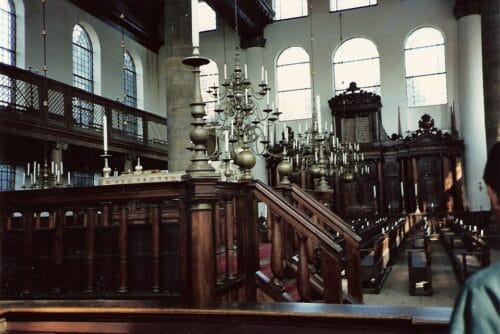
Fun Fact: The Jewish community contributed greatly to Amsterdam’s growth during the Golden Age, excelling in trade, science, and the arts.
Travelglaze Tip: Combine your visit with the nearby Jewish Historical Museum to gain deeper insights into Jewish life and culture in Amsterdam.
7. Mosques in Amsterdam: Reflecting the Modern Multicultural City
While mosques are not located in the historic canal district, they play a vital role in Amsterdam’s religious landscape of today. The city is home to over 50 mosques, reflecting its diverse Muslim community, which includes Moroccans, Turks, and Indonesians.
Highlight: The Westermoskee, or “Western Mosque,” is the largest mosque in Amsterdam, located in the Baarsjes neighborhood. Its Ottoman-inspired architecture and striking minaret make it a visual landmark.
Fun Fact: The Westermoskee was completed in 2015 after years of planning, making it a relatively modern addition to the city’s religious scene.
Travelglaze Tip: Take a stroll along the nearby canals of the Baarsjes district to explore this vibrant and lesser-known part of Amsterdam.
