


The free ferries are the most practical way to experience Amsterdam from the water. They are part of the city’s public transport system and connect different points across the IJ. For many people in Amsterdam, they are not a tourist activity at all, but simply part of the day. That already tells you something important: a ferry is mainly about getting from one side to the other, not about slow sightseeing. The ferries are free of charge and are meant for pedestrians, cyclists, mopeds and disability vehicles.
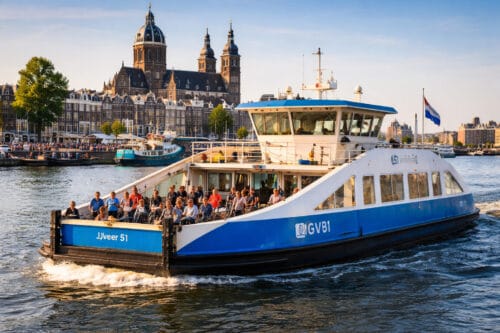
📍 Where ferries are most useful
For most visitors, the most useful ferry routes leave from behind Amsterdam Central Station. These are the ones that make the most sense if you want to combine a water crossing with a specific part of Amsterdam Noord.
- 🚶 Buiksloterweg (F3)
This is the best-known and best-served ferry for visitors. It is the most useful choice if you want a quick crossing to places like Eye Filmmuseum and Tolhuistuin, and it is also the one to mention for late arrivals or evening plans because this route runs throughout the night. - 🎨 NDSM Wharf (F4)
This route is more useful when the ferry ride is part of the outing, not just the crossing. It works well for STRAAT Museum, the wider NDSM area, creative spaces, restaurants, and IJ-Hallen, which is about a five-minute walk from the ferry stop. - ✨ IJplein (F2)
This is a less obvious choice for many visitors, but it can be useful if you want a quieter arrival point in Noord. One nearby place that is easy to mention here is WONDR, which I amsterdam describes as a short walk from IJplein.
GVB also runs other ferry routes in Amsterdam, but for this blog the Central Station ferries are the most relevant to visitors. For the latest ferry map and current departure times, it makes sense to add a short practical link to the GVB ferry overview here.
👣 What it feels like
Using a ferry in Amsterdam is usually simple and low-stress. The docks behind Central Station are clearly marked, and digital countdown boards show when the next ferry will arrive. Boarding is straightforward, and the crossings are short. Ferries also use wide ramps, which helps make boarding easier for many travellers, including people using wheelchairs or mobility aids.
🚲 Ferries are shared with commuters, cyclists and local residents, so the ride feels functional (and sometimes very crowded) rather than touristic. There is no commentary, no scenic route through the canal belt, and no real focus on comfort. That is not a weakness, but it is something worth knowing before you go. A ferry is a quick crossing with a local feel, not a classic sightseeing experience.
🎈 Fun fact
The Amsterdam ferries across the IJ are free of charge, even though other public transport in the city is not. That makes them one of the few ways to get a water experience in Amsterdam without buying a separate ticket.
💡 When to choose this option
A ferry makes most sense when the crossing itself is enough. It is a good choice for travellers who want a free and easy water experience, for visitors heading to Amsterdam Noord, or for anyone curious about seeing a more everyday side of the city. It is less suitable when the goal is comfort, explanation or a scenic canal route through the historic centre.
A canal cruise is the easiest way to see Amsterdam from the water without much effort. A canal cruise is made for sightseeing. The route is fixed, the boat does the work, and you can sit back and look at the canal houses, bridges and historic centre from the water. It takes around 60 to 75 minutes.
If you already know that a classic canal cruise suits your trip this is a practical place to start.
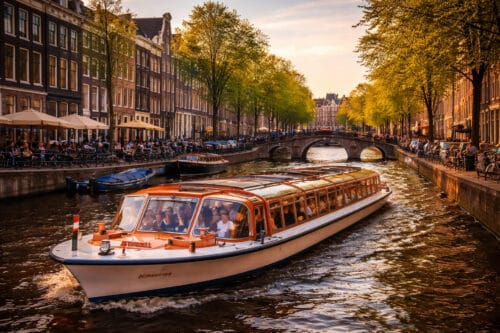
📍 Most useful departure areas and nearby attractions
- 🚉 Central Station / Damrak
This is usually the easiest departure area for first-time visitors, especially after arriving by train or when staying in the historic centre. It is a practical starting point if you want to combine a cruise with Central Station, Dam Square or a first walk through the old centre. Common departure points in this area include Central Station and Damrak. - 🏛️ Anne Frank House / Jordaan
This area makes sense if the cruise is part of a day around the Anne Frank House, Westerkerk, the Jordaan or the Nine Streets. Some standard city cruises also depart from this part of the centre, which makes it easier to combine sightseeing on foot with a boat ride. - 🎨 Rijksmuseum / Stadhouderskade / Leidseplein
This is the most useful area when your day is built around Museumplein, the Rijksmuseum, Leidseplein, Vondelpark or the Heineken Experience. Cruises also depart from this side of the city, so it can be a better fit than Central Station if your hotel or museum plans are already in the southern canal belt area.
It is worth checking the exact departure point before booking, because canal cruises are not all grouped in one place. Departure areas vary, even for similar one-hour routes.
👣 What it feels like
A classic canal cruise usually feels easy, structured and low-effort. Many standard cruises use covered boats, and audio guides are common. Some boats are also heated and have toilets on board, although this can vary by route and operator.
That makes a canal cruise especially useful for travellers who want to see a lot without much walking or decision-making.
🎈 Fun fact
Many canal cruises pass through Amsterdam’s UNESCO-listed canal belt, so the ride is not only scenic but also a way to see part of a protected historic city landscape from the water.
💡 When to choose this option
A canal cruise makes most sense as a strong choice for first-time visitors, short stays, rainy weather and lower-energy travel days, . Cruises are less suitable when you want complete freedom, a very quiet small-scale atmosphere or a ride that feels more personal. In those cases, a whisper boat usually fits better.
A whisper boat in Amsterdam is usually a small electric boat that you drive yourself. No boating licence is usually needed for this kind of small electric rental, and several providers explain that first-time visitors can do this without previous experience after a short introduction.
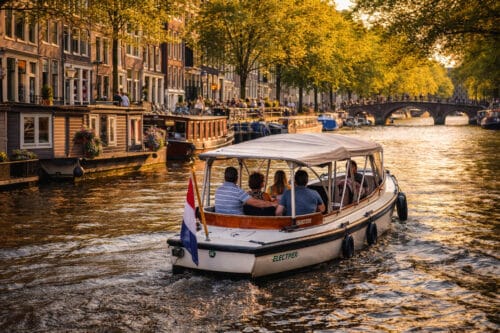
📍 Most useful boarding areas and nearby attractions
- 🌿 Nassaukade / Jordaan side
This is one of the most useful starting areas if you want a more classic Amsterdam setting. From here, you are close to the canal belt, and one central departure point on Nassaukade is specifically described as useful if you want to sail towards the Anne Frank House area. That makes this side practical for travellers combining a boat ride with the Jordaan, the Nine Streets or a slower afternoon in the historic centre. - 🚤 Mauritskade / eastern canal side
This side is useful when you want a little more space around you and a route that feels less centred on the busiest canal belt. Boarding points here are listed near Weesperplein and Wibautstraat, and one route description from an Amsterdam boat rental page specifically highlights places such as Artis, NEMO and the National Maritime Museum on the eastern side of the city. - 🌸 De Pijp / Amstel side
This is a good fit when your day is already built around Amsterdam South, De Pijp or the Amstel. One central boarding location is listed at Jozef Israëlskade near the Okura area, while another nearby Amstel-oriented departure point is described as ideal if you want to spend time on the river as well as the canals.
👣 What it feels like
A whisper boat usually feels quieter and more personal than a canal cruise. Because the boats are electric, the ride is softer and less noisy than on traditional fuel-powered boats. At the same time, this option asks more from the visitor. You steer the boat yourself, follow the boating rules yourself, and decide how confident or relaxed the route feels.
🎈 Fun fact
The name “whisper boat” comes from the quiet electric motor. The boat does not literally whisper, of course, but the ride is much quieter than with older fuel-powered boats, which is exactly why the name stuck.
💡 When to choose this option
A whisper boat makes most sense when freedom and atmosphere matter more than structure. It suits travellers who want to move at their own pace, bring their own snacks, and enjoy Amsterdam from the water without joining a larger group.
