🌿 Ibiza Beyond the Party Image
Most people think Ibiza is easy to explain. Beaches, clubs, sunsets, summer. That version exists, but it is not the whole island. Ibiza beyond the party image is older, quieter and far more layered than many visitors expect.
That is also where the island becomes more interesting. Not for travellers who want the loudest version first, but for those who are curious about what sits underneath the postcard image. Ibiza also has old towns, hippy history, unusual places and corners of the island that feel very different from its better-known reputation.
This guide looks at that side. 🌿 Not to deny the famous Ibiza, but to see what else is there if that version has never fully appealed to you. If you have ever wondered whether Ibiza might suit you more than you thought, keep reading.
In this guide, you can jump straight to:
🏺 Ibiza’s Historical Side
Ibiza’s history is much older than its party reputation. If you only know the island through beach clubs and sunsets, this part can come as a surprise. The older side of Ibiza is still very visible. You can walk through it, stand in it and in some places even look straight into it.
🏰 Dalt Vila
Short history
Dalt Vila is the old upper town of Ibiza Town. The walls you see today were built between 1554 and 1585. They were built to protect Ibiza against attacks from the sea, especially on the route between Spain and Italy and against Turkish raids and pirates.
📍 Where is it
It is right above the harbour in Ibiza Town. This is the old walled part of the city, so it is not somewhere out in the countryside. It is part of the town you are probably already walking through.
🚗 How do you get there
The easiest way is simply on foot from the port, Marina or the centre of Ibiza Town. The main entrance is Portal de Ses Taules, but there are other entrances too, including Portal Nou and the Es Soto Fosc tunnel.
🧡 Why visit
Dalt Vila does not feel like a dry history lesson. You walk through gates, along thick walls and past bastions that were built to control who came in and out. At the same time, there are steep lanes, little squares, stone steps, shops, cafés and wide views over the harbour. That mix makes it easy to enjoy, even if you are not usually a “fortress person.”
🎈 Fun fact
The walls took about 40 years to build and form an irregular heptagon with bastions at the corners. So even the shape of Dalt Vila was planned for defence, not beauty.
⚱️ Puig des Molins
Short history
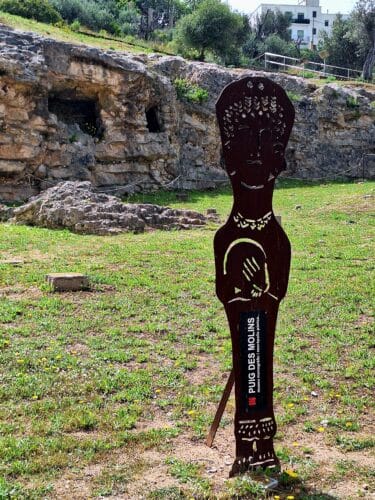
Puig des Molins was the ancient cemetery of Ibiza Town. It started in the 7th century BC with the Phoenicians and stayed in use through the Punic, Roman and Late Antiquity periods. So this is not one short chapter of history. It was used for centuries.
📍 Where is it
It lies inside Ibiza Town, about 500 metres south of the old urban core. That is one of the striking things about it. You are not visiting some remote archaeological site. You are visiting the ancient city of the dead right next to the living city.
🚗 How do you get there
It is easy to reach on foot if you are already in Ibiza Town. The museum address is Via Romana 31, so it works well as part of a town day rather than as a separate excursion.
🧡 Why visit
This site is easier to imagine than many archaeological places because the scale is so clear. The necropolis covers more than 5 hectares, with around 3,000 rock-cut tombs. That gives you a much stronger sense of how important ancient Ibiza once was. It is also one of those places that feels unexpectedly strange because it sits so close to the modern town.
🎈 Fun fact
The hill gets its name from the windmills that stood there from at least the 14th century. So even the name Puig des Molins tells you that this place carries more than one layer of island history.
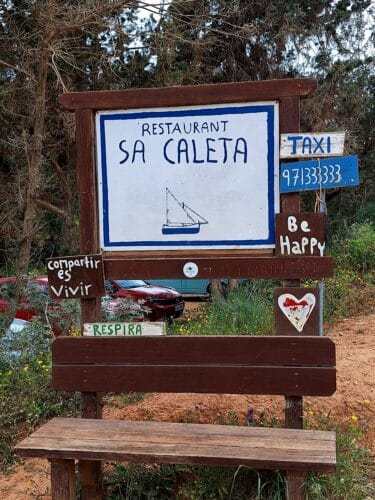
🧱 Sa Caleta
Short history
Sa Caleta takes Ibiza’s story even further back. This settlement dates from the end of the 8th century BC and is linked to the island’s first Phoenician occupation. It was not just a symbolic outpost. People here lived from agriculture, livestock, fishing, shellfish gathering, salt activity and metalworking.
📍 Where is it
Sa Caleta lies on a small peninsula on Ibiza’s south coast, between Es Codolar beach and Jondal mount. On one side there is the mouth of a stream and a small protected dock, which helps explain why the Phoenicians chose this spot in the first place.
🚗 How do you get there
This one is less of a town walk and more of a small outing. It makes the most sense if you have a car or take a taxi, because it sits outside Ibiza Town on the south coast.
🧡 Why visit
Sa Caleta feels rougher, quieter and less obvious than Dalt Vila or Puig des Molins. It is also the site that may disappoint some visitors most, because there is not much explanation on site and visually it is not very spectacular. But if you like history and want to see one of Ibiza’s earliest known settlements, it is still a meaningful stop.
🎈 Fun fact
Around 600 BC, Sa Caleta was abandoned, apparently in a planned and peaceful way. Archaeologists think the population then moved into Ibiza Bay, where the city later continued to grow. So this site may really be the first chapter of Ibiza before the story moved elsewhere.
🎈 Travelglaze fact:
These three places are part of the reason Ibiza received UNESCO World Heritage status in 1999. So the island’s heritage story is much bigger than just one pretty old town.
🌊 Can Marçà and Ibiza’s Smuggler History
🕳️ Short history
Can Marçà is one of those places where the story helps immediately. The cave was used by smugglers to hide goods brought in from the sea. They used the cave as a secret storage place, and you can still see the red and black marks they left behind to show the way in and out. That detail alone makes the visit easier to remember.
📍 Where is it
Can Marçà is in Port de Sant Miquel on the north coast of Ibiza, cut into the cliff above the bay. The setting is part of the experience. Before you even go inside, you already get wide sea views and that slightly dramatic feeling of standing high above the water.
🚗 How do you get there
This is easiest with a car. The cave is clearly signposted once you head down towards Port de Sant Miquel, and there is parking near the entrance area. At the top of the cliff there is also a small café, toilets and a souvenir shop, so it feels fairly easy and comfortable once you arrive.
🧡 Why visit
Can Marçà is a nice and unexpected stop. You get the cliffside setting, the sea view, the smuggler story and a guided visit all in one place. The tour takes about 35 minutes, and the guide makes a big difference because the stories are part of what makes this cave interesting.
You do need to walk quite a lot of steps to get down to the entrance and back up again. The good part is that they are well made and easy to walk for most visitors.
🎈 Fun fact
The cave stays at around 20°C all year, so even on a hot Ibiza day it feels cool as soon as you step inside.
🌿 Ibiza’s Hippy Heritage
Short history
The word hippy comes from hip. It was first used for a counterculture that rejected mainstream rules and wanted a freer way of living. On Ibiza, that story became visible from the 1960s and 1970s, when the island attracted people looking for freedom, art, music and a simpler life.
That is the period most people mean when they talk about Ibiza’s hippy side.
Ibiza’s hippy story is also tied to Adlib fashion. Adlib comes from the Latin phrase ad libitum, loosely translated on Ibiza as “dress as you like, and own it” The style was launched in 1971 and mixed traditional Ibizan clothing with the freer hippy look of the time. White, cotton, linen, lace and handmade details are still part of that style now.
📍 Where is it
You do not find Ibiza’s hippy heritage in one single building. You feel it most clearly in the northeast of the island, especially around the village of Sant Carles and the resort village of Es Canar. That is where two of the best-known hippy markets are: Las Dalias, a market in Sant Carles, and Punta Arabí, a market in Es Canar. Las Dalias started as a roadside bar in 1954 and its market began in 1985. Punta Arabí began in 1973 and is the island’s original large hippy market.
🚗 How do you get there
A car makes this side of Ibiza easiest. Las Dalias is on the road to Sant Carles, and there are 4 public parkings in the area nearby. Punta Arabí in Es Canar also has paid parking areas right in front of the site. you can read more in my guide to Ibiza in spring.
🧡 Why visit
This part of Ibiza matters because it explains a lot about the island that beach clubs cannot. It helps you understand why Ibiza still has such a strong handmade, alternative and slightly nonconformist side. Even now, people come here for markets, music, craft, loose dress codes and a less polished version of island life. That is a big part of what many visitors mean when they say Ibiza feels different.
🎈 Fun fact
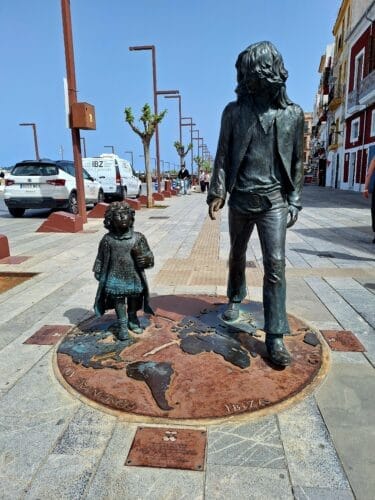
Ibiza Town even has a hippy monument in the harbour area: a bronze sculpture of a father and child, unveiled in 2016 and inspired by an iconic Toni Riera photo linked to Ibiza’s hippy image. Some reports say the original photo was actually taken in Amsterdam’s Vondelpark.
🪨 Time and Space
Short history
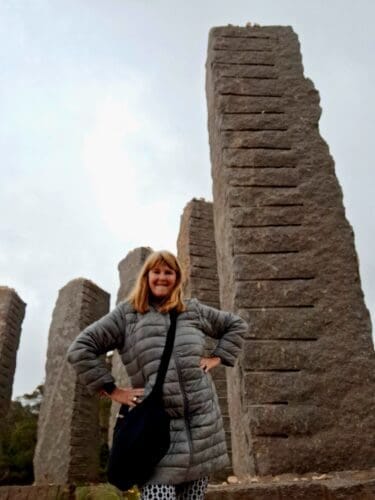
Time and Space is often called Ibiza’s Stonehenge, but it is not ancient at all. It was created in 2014 by the Australian artist Andrew Rogers and commissioned by Guy Laliberté, the founder of Cirque du Soleil. The comparison with Stonehenge comes from the circle of dark stone columns on the cliff, not from its age.
A few steps away, there is another artwork that makes the place even stranger: the two wooden doors known as the Doors of Cala Llentia or Las Puertas de Can Soleil. They stand facing each other like a room without walls, and from the right angle they frame the sea and Es Vedrà.
📍 Where is it
Time and Space stands on the cliffs near Cala Llentia on Ibiza’s west coast. It is not one of the island’s best-known stops, and that is part of the appeal. You do not arrive at a big organised attraction. It feels more like a place people find because they were looking for it.
🚗 How do you get there
A car is the easiest way. You drive towards the Cala Llentia / Can Soleil area, park, and then walk the last part. There is no clear parking spot or big signs, and it is a bit remote, but worth the trip!
🧡 Why visit
Time and Space is a special stop for travellers who like places with atmosphere, not just big names. It is quiet, a little mysterious and much more impressive in real life than it sounds on paper. You get the sea, the cliffs, the dark stone pillars and the doors nearby all in one place.
It also feels different from many of Ibiza’s more obvious stops. There is no big setup around it, no crowd pulling you through, and no fixed visitor route. That makes it a good place for travellers who enjoy finding something beautiful and unusual without turning it into a whole production.
🎈 Fun fact
The monument is made up of 13 basalt columns, and visitors often try to throw little stones on top of them. So if you see tiny piles of stones balancing up there, those are not part of the original artwork. They were left by people who wanted to add their own small challenge to the place.
🌿 Final Thoughts
If the usual Ibiza image has never fully appealed to you, this side of the island may suit you much better. 🧡 Old walls, ancient burial sites, smuggler stories, hippy history and strange cliffside art give Ibiza more depth than many people expect.
⏳ The nice thing is that these stops do not have to take over your whole day. Most of them are quite manageable, which makes them easy to combine with a slow and comfortable Ibiza trip. And if slow travel is your style, even one stop like this per day can already be enough.
💬 I would love to know which side of Ibiza appeals to you most. Would you choose the old town, the hippy history, the cave, or Time and Space?
- Muiden & Muiderberg in a Day: A Calm Escape East of Amsterdam
- Comfortable Day Trips East of Amsterdam
- Hidden Gems in Barcelona: 7 Unique and Surprising Experiences
- How to Prepare for a City Trip to Barcelona
- Ibiza in Spring: What to Expect in March, April and May
- Istanbul with Girlfriends: Fun, Food & Relaxed City Experiences
📍 Where is it
📍 Where is it