Finding Your Travel Style: 5 Comfortable Ways to Explore a City

Whether you love green parks, quiet cafés or wandering old streets — there's a city rhythm that fits the way you like to travel.

by Kitty


In part one of this blog series, we explored travelers who love local life, history, or planning their city trip with care. But not everyone travels with a map in hand.

Some people move through a city more quietly — no checklist, no tight schedule. They enjoy the in-between moments: a shady bench, the way a street smells after rain, or a slow café morning with no agenda at all.

This second part is for those comfortable city travel types — the ones who prefer calm over crowds and moments over milestones.

This blog is for them.

How to explore this blog comfortably:
Click below to jump to a section — or just scroll through at your own pace (tea in hand optional).

🚶 The Flâneur

Wanders without purpose. Finds meaning anyway.

The Flâneur doesn’t plan the day — the day reveals itself. They stroll through cities the way others browse secondhand bookstores: not looking for anything in particular, but open to being surprised.

This kind of traveler doesn’t mind getting a little lost. In fact, they expect it. They might spend twenty minutes watching pigeons in a courtyard or follow the scent of bread until it leads to a backstreet bakery. They’re not in a hurry, and that’s exactly the point.

You often find flâneurs in cities like Lisbon, Paris, or Ljubljana — places where beauty hides in small angles and uneven streets.

🌿 TravelGlaze Tip

Skip the itinerary. Choose a neighbourhood you don’t know well, and explore it with one gentle rule: always take the smaller street.

Bonus idea? Walk the same loop twice — once in the morning light, and once just before dinner. You’ll see two completely different cities.

🧠 Fun fact

In 19th-century Paris, the flâneur wasn’t just a casual stroller — it was a cultural figure, especially admired by artists and writers. A flâneur was someone who wandered the city streets not with a goal, but with a sharp eye and a curious mind.

Writers like Charles Baudelaire saw the flâneur as a kind of “urban observer,” blending into the crowd while quietly studying it. This way of walking became a symbol of modern city life — thoughtful, reflective, and just detached enough to notice everything.

You could say the flâneur was the original travel blogger… just with better posture and more elegant shoes.

🗺️ The View Seeker

Always looking for a little height — and a lot of perspective.

The View Seeker loves rooftops, terraces, towers and lookouts. Not for the bragging rights, but for that quiet moment when a city unfolds in front of you — soft skyline, church bells, laundry lines and all.

This kind of traveler might not care much for museums, but will happily climb 300 steps for the reward of a hazy skyline at sunset. They pause at every railing. They time their day around golden hour.

Golden hour view from a river to a big city

🌿 TravelGlaze Tip

Want the best view? Skip the famous tower and find the quieter lookout. In Nice, try the cemetery on Castle Hill. In Amsterdam, take the public library terrace. In Lisbon, almost every miradouro is free — and comes with a breeze.

No ticket needed. Just timing.

🧠 Fun fact

The word “panorama” comes from the Greek pan (meaning “all”) and horama (“view”). The term was first used in the 18th century to describe wide, sweeping scenes — not just in art, but as a way of seeing the world.

Before photography, artists would climb towers and church domes to sketch entire cityscapes by hand. These detailed circular views were later displayed in 360-degree viewing rooms — the original immersive experience.

Some even brought a small picnic for the climb, knowing they’d be up there for hours. A good view has always been worth the effort.

🌳 The Nature Lover

Happiest where things grow and time slows down.

The Nature Lover doesn’t need wilderness — a park bench, a garden path, or a courtyard full of hydrangeas is enough. They seek out calm spots with leaves overhead and gravel underfoot. The city fades a little when there’s something green to focus on.

They travel with a reusable bottle and a quiet appreciation for trees. If there’s a botanical garden, they’ve already bookmarked it.

🌿 TravelGlaze Tip

Want to slow down mid-city? Look for places with benches and birds. Even busy cities like Paris and London have hidden green corners — and Amsterdam’s parks offer the perfect calm between city moments.

Arrive early — before the joggers and the leaf-blowers.
And if you’re short on time? One shady square with a good tree can be enough.

🧠 Fun fact

The Hortus Botanicus in Leiden, founded in 1590, is one of the oldest botanical gardens in the world — and a true hidden gem in the Netherlands. It was originally created by the University of Leiden as a medicinal garden, where doctors and students could study healing plants up close.

Over the centuries, it became a living library of rare and exotic species. In fact, it was one of the first places in Europe where the tulip was cultivated — long before tulip mania bloomed across the country.

Today, it’s still part of the university, but open to anyone who enjoys a quiet walk between ancient trees, orchids, and even a Japanese garden. It’s peaceful, scientific, and unexpectedly poetic — still full of cures, just quieter ones.

🪟 The Window Sitter

 Doesn’t mind missing the action — as long as there’s a view (and maybe a local chat).

The Window Sitter finds a quiet café, chooses the corner seat, and simply… watches. Not in a rush. Not in a mood to be anywhere else. They might stay for an hour or two — observing umbrellas, dogs, a child with a balloon.

And if someone local sits nearby? Even better. A small conversation about the weather, the menu, or where to get the best bread — these quiet exchanges make the place feel more alive.

🌿 TravelGlaze Tip

Don’t feel guilty for sitting still. Find a café with a window and let the city come to you. Rainy days are best. Bonus points if the café has a wobbly table, friendly staff, or an older couple who come there every day.

And if you’re in Nice? Rue Bonaparte has excellent people-watching potential.

🧠 Fun fact

The habit of turning chairs toward the street — what we now call “terrace culture” — began in Copenhagen in the 1960s. Cafés started arranging their outdoor seating not around tables, but facing outwards, toward the flow of life.

It wasn’t about eating or drinking quickly — it was about watching. Neighbours passing by, children on bikes, someone walking their dog three times a day. This simple idea created a new kind of urban theatre — one where everyone could be both audience and actor.

The idea spread quickly across Europe, especially to cities like Paris and Amsterdam, where sitting still and observing became part of daily life.

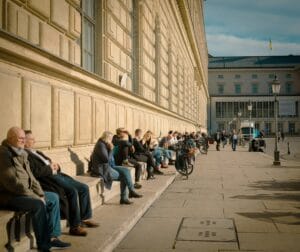
So next time you find a chair with a view, take it. That’s not just coffee — it’s tradition. people sitting on a sidewalk
🧭 The Serendipity Finder

Never looking. Always finding.

The Serendipity Finder doesn’t travel with a checklist. They leave room for unexpected moments — and somehow, those moments find them. A hidden alley. A tiny bakery. A local market just packing up.

In South Korea, I once stopped at a quiet parking lot — just to check my map. It turned out to be a local meeting spot, full of chatter, scooters, and families on benches. And right there in the food mall was a fully automated coffee stand, run by impressive looking robots. And it was good cofffee as well.

🌿 TravelGlaze Tip

Plan one “unplanned hour” into each travel day. Don’t fill the whole day with freedom — that gets overwhelming. But one open window is enough to let something surprise you.

Still nervous? Start by stepping off at a tram stop that isn’t yours.

🧠 Fun fact

The word serendipity was coined in 1754 by the British writer Horace Walpole. He was inspired by a Persian folktale called “The Three Princes of Serendip,” in which three royal brothers travel the world and keep making unexpected discoveries — not because they were looking for them, but because they paid attention.

The word has stuck ever since, describing those little moments where something lovely appears just when (and where) you least expect it. A garden in a quiet courtyard. A street musician on a bridge. A coffee stand run by robots in a parking lot in South Korea.

That’s the real art of the Serendipity Finder: not chasing, just noticing.

✨ A Travelglaze Note

I never quite stick to one travel type. Some mornings I’m a Flâneur, slow and aimless. By afternoon, I might climb a tower like a View Seeker or turn into a full-on Museum Nomad (yes you are right – I did not mention this type of traveler before. But I will in part 3!)
And that’s the beauty of it — we’re not made to fit into just one travel shape.

That kind of flexibility only works because I usually plan more days than most people would for a city trip. I don’t rush, but I do want to experience. And I’ve learned that giving yourself time — real, open time — is the most comfortable way to travel.

It’s not about doing less. It’s about doing things with space to enjoy them.

🌙 Final Thought

There’s no one right way to explore a city. Whether you walk aimlessly, find a secret garden, or sit by a window for an hour — it all counts. These quiet travel types remind us that slowing down doesn’t mean missing out. It often means noticing more.

And if you don’t see yourself in just one of these travelers? Even better. Travel can shift with the hour, the weather, or your mood.

In part three of this series, I’ll introduce a few of the more unexpected types I’ve met along the way — the ones who explore in slightly quirkier ways.
You might recognize yourself there too.

💬 Which one are you today?
Let me know in the comments — or suggest your own quiet travel type. I’d love to hear who’s out there, noticing the in-between moments.

Leave a Comment

You may also like

Travelglaze
Blog about travelling the world with wonder - for the somewhat older people