


Spain’s great cities are often celebrated for sunshine, tapas, and lively plazas. But behind the music and bright façades, Barcelona and Madrid hide a quieter layer of history—one filled with ghost stories, strange symbols, and legends that have lingered for centuries.
From Gaudí’s dragon on the rooftops of Barcelona to the vanished bride of Madrid’s House of the Seven Chimneys, these tales are part of the cities’ charm. They are not about fear, but about wonder—the kind of stories you stumble upon when you slow down and look closer.
The best part? Every legend is tied to a real place you can visit today. Think of them as day trips with a touch of mystery: a cathedral cloister where shadows whisper, a hidden skull carved into a quiet alley, or a fountain on a grand square that once ran red.
If you’re planning a trip, start practical and comfortable: read my guide How to Prepare for a City Trip to Barcelona for routes, neighborhoods, and timing. Flying in? This comfortable guide to Barcelona–El Prat Airport helps you arrive calm and ready. Then add a touch of mystery with the stories below—always linked to real places you can visit at an easy pace.

👉 Ready to explore Barcelona’s hidden legends? Jump to your story here:
This article is also featured on GPSmyCity. To download this article for offline reading or create a self-guided walking tour to visit the attractions highlighted in this article, go to Walking Tours and Articles in Barcelona.
In the heart of the Gothic Quarter rises the Cathedral of the Holy Cross and Saint Eulalia. Its soaring towers and gargoyles already cast a dramatic shadow, but locals whisper of a ghostly bishop who still roams its halls.
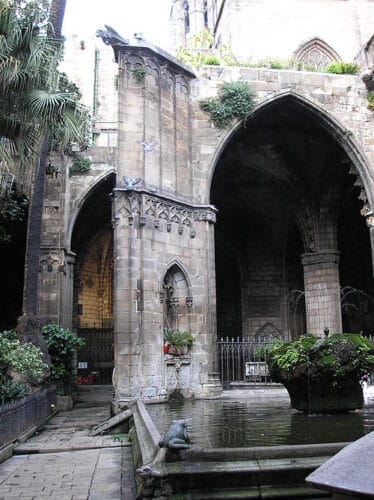
Picture taken by deror avi
According to the legend, a clergyman who once served the cathedral was accused of corruption and died without clearing his name. His restless spirit is said to wander the cloisters, muttering prayers that echo faintly among the stone arches. Some visitors have claimed to feel a sudden chill in the peaceful garden, or to notice a figure vanishing between the orange trees.
The cathedral itself is filled with layers of history: Roman foundations, medieval chapels, and the crypt of Saint Eulalia, the city’s young martyr. Perhaps it is this deep sense of devotion and tragedy that keeps the ghost bound to the site.
Practical Information
Address: Pla de la Seu, s/n, 08002 Barcelona
Tickets: Entry to the cathedral and cloister is ticketed (free in the morning before services, small fee otherwise). Roof access is available for a modest extra charge.
Getting there: Metro L4 to Jaume I or L3 to Liceu, both a short walk.
Travelglaze Tip: Step into the cloister garden, where thirteen white geese live as a symbol of Saint Eulalia’s martyrdom. It’s a surprisingly quiet corner in the middle of the Gothic Quarter—and if you linger by the fountain, you’ll understand why legends say spirits prefer this part of the cathedral.
In the early 1900s, Barcelona was shocked by the case of Enriqueta Martí, a woman who became known as the Vampire of Barcelona. Living on the edge of the Gothic Quarter and Raval, she disguised herself as a beggar by day, but rumours spread of far darker activities behind her closed doors.
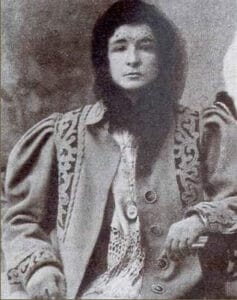
According to newspapers of the time, she kidnapped children and used their blood and bones to create potions and ointments, which she sold to wealthy clients as secret cures. While many details were exaggerated by sensationalist press, her arrest in 1912 confirmed that children had indeed disappeared under mysterious circumstances. To this day, her story remains one of the most chilling legends of Barcelona.
Locals still whisper her name when passing the narrow streets where she once lived. Some say that shadows linger too long in the alleys near Carrer de Joaquín Costa, and that Martí’s ghostly figure appears on foggy nights. Whether true or not, the Gothic Quarter has never completely shaken off her reputation.
Practical Information
Location: The main sites of Enriqueta Martí’s story were in Carrer Ponent (today Carrer de Joaquín Costa) and the surrounding Gothic Quarter.
How to explore: There is no museum, but several walking tours of the Gothic Quarter include her story. You can also trace the streets yourself as part of an evening stroll.
Travelglaze Tip: Start at Plaça del Pedró, a small square just steps from the busy La Rambla, and wander into Carrer de Joaquín Costa. It’s a lively but less touristy corner filled with cafés, where the Gothic atmosphere and Martí’s legend mix with the comfort of a quiet evening drink.
