NDSM Amsterdam: Street Art, History, Food and Ferry Tips

Explore Amsterdam’s former shipyard with STRAAT Museum, IJ-Hallen, waterfront cafés and practical ferry information.

by Kitty

⚓ Amsterdam across the IJ

Amsterdam’s historic centre gets most of the attention, but just across the IJ another side of the city is waiting. NDSM is a former shipyard in Amsterdam-Noord, now filled with street art, creative studios, industrial buildings, cafés and cultural spaces.

This is the NDSM warf in Amsterdam, a former shipyard.Getting there is part of the experience. A free ferry from behind Amsterdam Central Station takes you across the water, and within minutes the city feels completely different. The wide open space, old shipyard structures and large-scale art give NDSM a character you will not find in the canal belt.

This guide shows what NDSM is, what is worth seeing, how much time to allow and how to combine the area with places such as STRAAT Museum or IJ-Hallen.

💡 Fun fact: NDSM is often casually called an island, but it is not one. It is a waterfront area in Amsterdam-Noord on the northern side of the IJ.

If you would like to understand Amsterdam’s ferry system first, this guide to the Amsterdam ferries is a useful place to start.

🧭 What to explore at NDSM

NDSM is large enough to wander around, but most of the places worth seeing are within easy walking distance of the ferry. Use these sections to plan what you want to include in your visit.

From shipyard to creative district
🎨 Street art inside and outside
🏗️ What to look for around NDSM
🛍️ IJ-Hallen and events
Where to stop for food or a drink
⛴️ How to get to NDSM

Some links in this article are affiliate links, shared as practical options to keep planning simple.

From shipyard to creative district

⚓The large halls, cranes, slipways and open spaces at NDSM still show what this area was built for: shipbuilding. For decades, this part of Amsterdam-Noord was a working industrial site where large ships were constructed and repaired.

The site takes its name from the Nederlandsche Dok en Scheepsbouw Maatschappij. Shipbuilding took place here from the late 19th century until 1979, and the yard grew into one of the most important shipyards in the Netherlands. Cargo ships and tankers were built here, and around 1950 it was even the largest shipyard in Europe.

When the shipyard closed, the huge industrial site lost its original purpose. From the late 1990s, artists and cultural makers started using the empty buildings and created studios and workspaces inside the former shipbuilding halls. That transformation gradually turned NDSM into the creative district you see today.

🏗️ Look at the buildings before the art

It is easy to arrive at NDSM and immediately focus on the murals and colourful containers. But the industrial structures are part of the story too.

The enormous NDSM Loods, for example, was once used for shipbuilding. Today, its roughly 20,000 m² interior contains studios and workshops for around 200 artists and makers. Other parts of the old yard have become restaurants, event spaces and cultural venues, while several original shipyard structures remain visible outside.

That mix of old and new is what makes walking around NDSM worthwhile. You do not need a fixed route. Leave some time to look at the scale of the buildings, the old machinery and the waterfront before moving on to the better-known attractions.

💡 Fun fact: The NDSM grounds cover about 10 hectares — roughly the size of more than ten football pitches.

Street art inside and outside

🎨 Street art is one of the main reasons people visit NDSM today. Some works stay for years, while others change regularly. The large industrial walls and open spaces make the area especially suitable for murals, graffiti and large installations.

Streetart showing a portrait of Anne Frank on the NDSM Straat museum

🖼️ STRAAT Museum

The best-known place is STRAAT Museum, inside an 8,000 m² former shipbuilding warehouse. The museum shows more than 180 works by over 170 artists from around the world. Many pieces are several metres high, so the scale feels very different from a traditional museum.

The building itself is part of the experience. The high ceilings, steel construction and industrial character give the artworks plenty of space and fit naturally with the history of NDSM.

📍 Practical information

  • Opening hours: Monday 12:00–17:00; Tuesday to Sunday 10:00–17:00.
  • First Friday of the month: open until 21:00.
  • Tickets: a ticket is required to visit the museum. Booking in advance is recommended, especially at weekends and during busy periods.
  • Time needed: allow around 1.5 to 2 hours for a comfortable visit.
  • Location: STRAAT is directly on the NDSM wharf, a short walk from the ferry.

Opening hours can differ on special dates, so check the official STRAAT website before visiting.

🎭 Free street art around NDSM

You do not have to enter STRAAT Museum to see street art at NDSM. The outside walls of the museum and other parts of the wharf form what STRAAT describes as Amsterdam’s largest graffiti hall of fame. Painting is tolerated here, which means the walls change regularly as new work appears.

This makes the outdoor area worth exploring even if you do not plan to visit the museum. Murals, graffiti, painted containers and temporary artworks are spread across the site, and what you see may be different on your next visit.

💡 Fun fact: The large portrait of Anne Frank on the outside of STRAAT, Let Me Be Myself by Brazilian artist Eduardo Kobra, covers around 240 m².

What to look for around NDSM

🏗️ Once you leave STRAAT Museum, there are several details on the former shipyard that are worth finding.

⚙️ The old shipbuilding structures

Several original parts of the yard are still visible, including the Scheepsbouwloods, the Lasloods, the Smederij and the old slipways where ships were once built and launched.

These structures help explain the enormous scale of the former shipyard. Even when the buildings now have a different use, their size and industrial design are still easy to recognise.

🏀 NDSM Giants

Near the 3×3 basketball courts stand three large concrete figures known as the NDSM Giants. Each is around eight metres high and represents a basketball player in motion. They are one of the easiest public artworks to recognise on the site.

🎨 Temporary public art

NDSM also has temporary outdoor installations that change over time. Some stay for a few months, others for several years. In 2026, works on the site include Wish Me Well and other large-scale installations created for the wharf.

Because the outdoor collection changes, it is worth checking the current NDSM art programme before your visit if public art is one of your main reasons for going.

🌊 The waterfront

Do not skip the edge of the IJ. From the waterfront you get wide views over the river, passing ferries and the city on the opposite bank. It is also one of the best places to understand how large the former shipyard actually is.

IJ-Hallen and events

🛍️ NDSM changes character when there is a market or festival. On a normal day, the wharf feels spacious and easy to explore. During a large event, it can become much busier, and that is worth checking before you go.
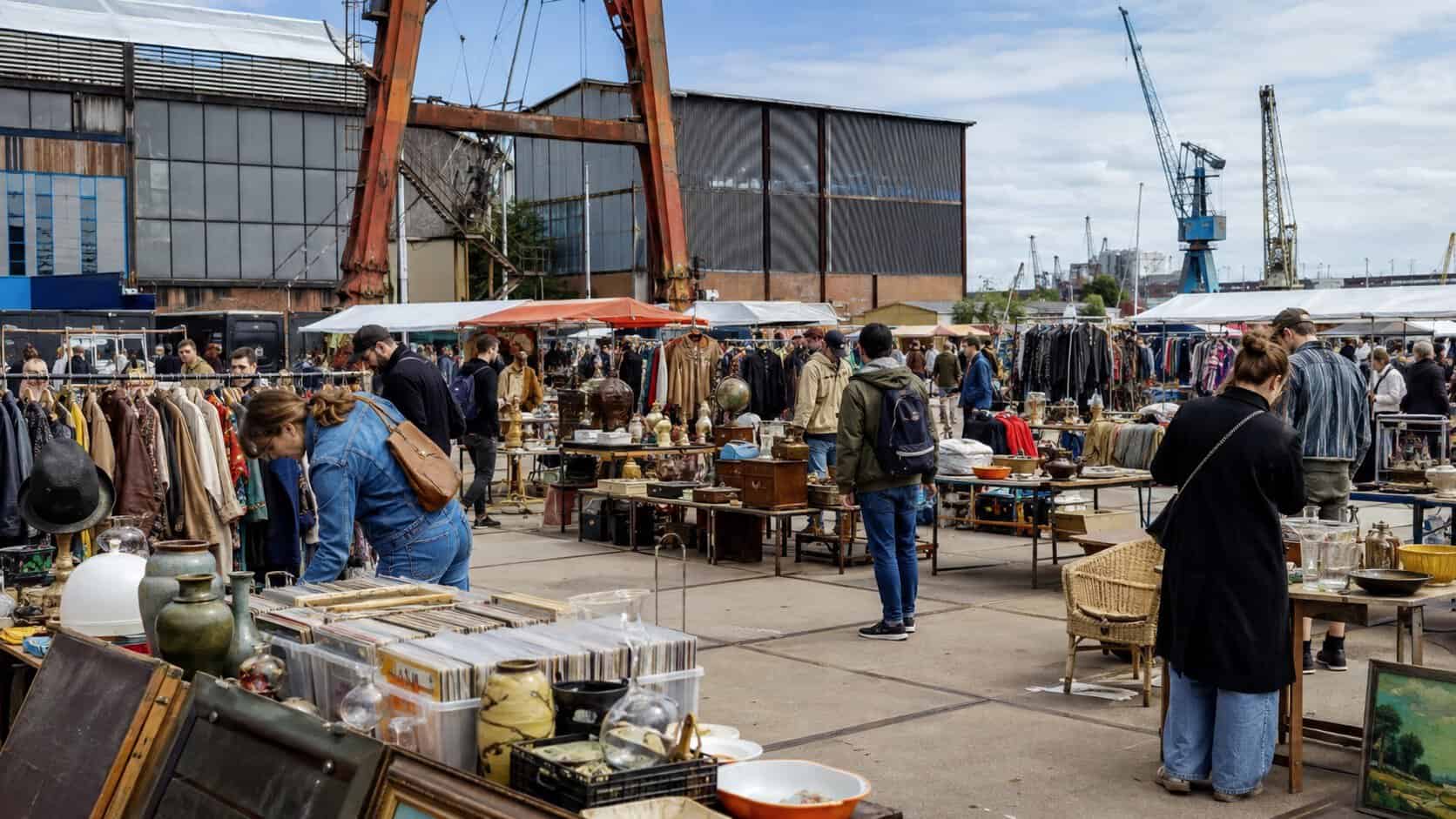
Some vintage stalls and visitors of the IJ-hallen at the NDSM warf in Amsterdam

🧺 IJ-Hallen

The best-known event is IJ-Hallen, one of the largest flea markets in Europe. It takes place about once every three weeks at NDSM. In spring and summer, the market is usually outside on the wharf. In autumn and winter, it moves inside the NDSM Loods.

A typical summer edition has around 750 stalls, with second-hand clothes, records, homeware, vintage finds and plenty of unexpected items. In 2026, summer editions run from 09:00 to 16:30. Tickets are required for visitors.

If IJ-Hallen is one of the main reasons for your visit, check the official calendar before choosing your date. The market is not held every weekend.

🎪 Festivals and other events

NDSM is also used for music festivals, cultural events, markets and exhibitions throughout the year. In 2026, the programme includes events such as Ambacht in Beeld Festival in September and Into the Woods ADE in October. Smaller events, exhibitions and performances take place as well.

This matters even if you are not planning to attend one. Large events can make the ferry, cafés and outdoor areas much busier than usual, while some parts of the wharf may be used for event infrastructure.

🧭 Travelglaze Tip

If you mainly want to explore NDSM, STRAAT and the waterfront, a day without a major event will usually be easier. If you enjoy markets and a livelier atmosphere, plan your visit around IJ-Hallen instead. Both give a different experience of the same place.

Where to stop for food or a drink

☕ NDSM has enough places to eat and drink that you do not need to return to the city centre for lunch or dinner. The best choice depends mainly on whether you want a quick stop, a proper meal or a seat by the water.

🌊 Pllek

Pllek is one of the best-known places at NDSM and sits directly on the IJ. It combines a restaurant, terrace and cultural programme, so it works well if you want to take a longer break rather than just stop for coffee.

The kitchen is open every day until 22:00. The restaurant itself stays open later, especially on Friday and Saturday. Only indoor tables can be reserved; the terrace is walk-in only. On Sundays, and during IJ-Hallen weekends, lunch reservations are not available.

📍 Address: T.T. Neveritaweg 59, 1033 WB Amsterdam
🕒 Opening hours:
Monday–Thursday: 09:30–01:00
Friday–Saturday: 09:30–02:00
Sunday: 09:30–01:00
🍴 Kitchen: daily until 22:00

🍕 De Pizzabakkers NDSM

For something more casual, De Pizzabakkers NDSM serves thin Roman-style pizzas and Italian drinks. It has a large indoor restaurant and terrace and is very close to the ferry landing, making it an easy choice at the beginning or end of your visit.

The restaurant is open daily, while the separate lunch menu with salads and focaccia is available from Thursday to Sunday. Reservations and takeaway are both possible.

📍 Address: NDSM-Kade 8, 1033 PG Amsterdam
🕒 Opening hours: daily 12:00–22:00
🥗 Lunch menu: Thursday–Sunday from 12:00

☕ Van de Werf

Van de Werf sits directly opposite the ferry and is the most practical of these three if you want breakfast, coffee or a meal close to your arrival point. It serves breakfast, lunch, dinner and drinks and has views across the IJ.

It opens from 09:00 every day. The official website currently confirms that it is open seven days a week, but does not publish one fixed closing time for every day, so it is worth checking the current schedule if you plan to stay late.

📍 Address: NDSM-Kade 2, 1033 PG Amsterdam
🕒 Opening hours: daily from 09:00
Extra in 2026: coffee and tea are €1 between 09:00 and 10:00 each morning.

🧭 Travelglaze Tip

If you combine NDSM with STRAAT Museum, I would explore the wharf first, visit the museum and plan your longer food stop afterwards. Van de Werf is easiest for an early coffee or breakfast, De Pizzabakkers works well for a straightforward lunch, and Pllek is the better choice when you want to sit by the water and take more time.

How to get to NDSM

⛴️ For most visitors, the ferry is the easiest way to reach NDSM. The GVB ferries across the IJ are free for pedestrians and cyclists.

🚶 From Amsterdam Central Station

The F4 ferry runs directly from behind Amsterdam Central Station to NDSM-Werf. Follow the signs to the ferries at the rear of the station and choose the F4 to NDSM.

The crossing takes about 14 minutes and brings you directly to the wharf, close to STRAAT Museum, restaurants and the main outdoor area.

🚲 From Pontsteiger

The F7 ferry connects Pontsteiger in Amsterdam-West with NDSM-Werf. The crossing takes about 7 minutes.

This route can be useful if you are staying around Westerpark, the Houthavens or the western side of Amsterdam. Bicycles are allowed on the ferry.

🚗 By car

NDSM can also be reached by car. There is a parking garage at the wharf and paid street parking in the surrounding area.

For most visitors staying in central Amsterdam, the ferry is usually the simpler option. A car is more practical if NDSM is part of a wider trip through Amsterdam-Noord or if you are arriving from outside the city.

📍 NDSM-Werf: NDSM-Plein, 1033 WB Amsterdam

✨ Final thoughts

NDSM can easily be part of a wider day in Amsterdam-Noord. After the former shipyard, you can continue towards the quieter side of the district, where old villages such as Ransdorp and Durgerdam show a completely different part of Amsterdam.

The contrast is what makes the combination interesting: industrial heritage and street art at NDSM, followed by wooden houses, dikes and village history further east.

If you want to see more of this side of the city, continue with my guide to Amsterdam’s old villages.

Have you been to NDSM, or would you add it to your next Amsterdam visit?

This article is based on personal travel experience and independent research. AI tools may be used to support research and editing; all information is reviewed before publication.

You Might Be Interested In

Leave a Comment

You may also like

Travelglaze
Blog about travelling the world with wonder - for the somewhat older people